Submission
To
Omagh Bomb Public Inquiry 2025
From
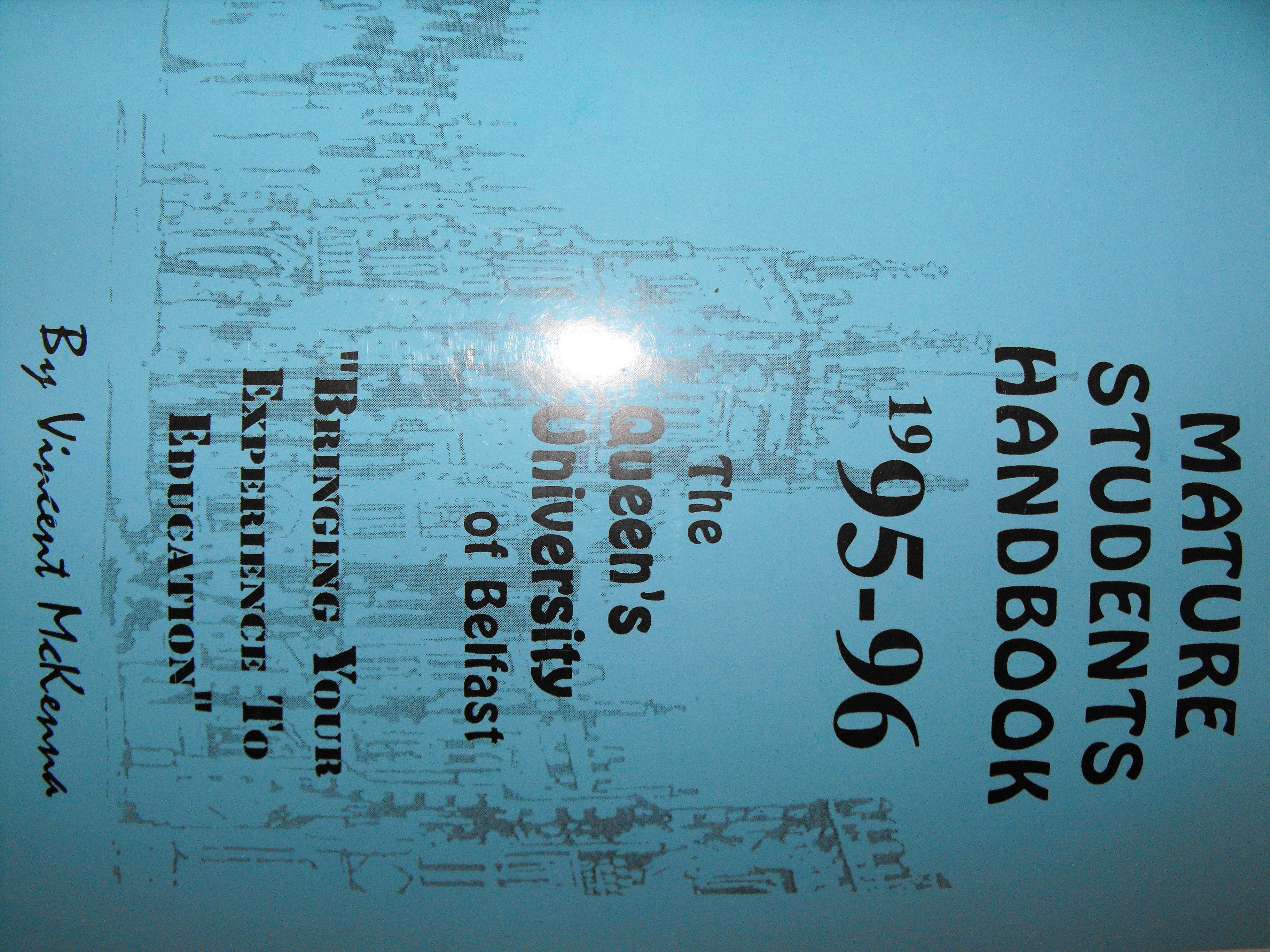
Vincent McKenna BSSc PGDipSSc MSc Certified Digital Marketing Professional
I, Vincent McKenna, Certified Digital Marketing Professional, being 18 years and upward make Oath and say as follows:
I initially made contact with The Omagh Bomb Public Inquiry on 4 June, 2024 and that contact was acknowledged. I made a number of follow up contacts in order to help The Public Inquiry establish my security credentials, these contacts were also acknowledged by The Omagh Bomb Public Inquiry.
On Wednesday, 8 January, 2025, I received an e-mail and letter from The Omagh Bomb Public Inquiry asking that I provide a 'Witness Statement', very specific parameters within which I should present my 'Witness Statement' were set-out in the letter received, 8 January, 2025. These parameters exclude the fact that I was working closely with RUC Special Branch and MI5 shortly after the Omagh Bomb, my work preventing many murderous atrocities by both Orange and Green Terrorist Criminals.
Having taken time to consider the manner in which I was being directed to compile my Statement to The Omagh Bomb Public Inquiry, and the clear lack of consideration given to the material already supplied to The Omagh Bomb Public Inquiry by me, it appears at this time that I will not be able to assist The Omagh Bomb Public Inquiry as it appears to have a pre-set agenda.
Families Against Intimidation and Terror 1998
From the PIRA Army Convention in Donegal in October, 1997 to end of February, 1998 when my cousin Seamus McKenna constantly told me that the Sinn Fein/PIRA Leadership, namely, Thomas 'Slab' Murphy, Kevin McKenna and Martin McGuinness were allowing the Real IRA to empty PIRA Arms dumps, I had met with and challenged my cousin Kevin McKenna (PIRA Chief of Staff, 1983-1997). At the end of February, 1998, I had already taken a firm stand against Sinn Fein/PIRA in Belfast, however, Kevin McKenna believed he could bring me back in from the cold.
Irish Government did NOT want Public call-out for Information on Omagh Bombers
I drove again to meet with Kevin McKenna in Smithborough, County Monaghan. Kevin McKenna asked me to drive to a shed outside Oldcastle in County Meath. Kevin directed me to the location, but never disclosed the reason for travelling there on our journey. I had no idea what was going to happen when we reached the location, I could have been tortured and murdered, I simply did not know. When we reached our destination, we entered a shed and we were met by Michael McKevitt and Seamus McGrane, both founding members of the Real IRA, which was still in its embryotic stages.
Kevin McKenna had a forthright conversation with Michael and Seamus, however, they were not prepared to wait any longer on Gerry Adams to deliver an agreed settlement with the British Government which would include the abandonment of Articles 2 and 3 of Bunreacht na hEireann (Irish Constitution) and still leave the British with a veto over the constitutional future of Northern Ireland. On this occasion, Kevin McKenna did not challenge Michael McKevitt about emptying PIRA arms dumps. In the 1970s two young men who had allegedly misused a single Provisional IRA gun had been brought from Belfast to a house at Park Street, Monaghan Town, later murdered and secretly buried by the Provisional IRA for taking the weapon without authority.
In 1982, Provisional IRA members, Colm Lynagh and Barry Kerr took a Provisional IRA weapon without permission and murdered an innocent civilian Gabriel Murphy in Emyvale, and no action was taken by the Provisional IRA as Colm Lynagh's brother, Jim Lynagh was a high ranking member of the Provisional IRA. The Provisional IRA were flexible when it suited their agenda.
When we left the meeting with Michael and Seamus, I asked Kevin McKenna what he was going to do about Michael emptying PIRA arms dumps and Kevin said:
"The odd bomb going off here and there will keep unionists focused on working with the doves".
As we drove away for this meeting outside Oldcastle, Kevin McKenna asked me to drive him to Mullagh in County Cavan, a short distance from our meeting with Michael McKevitt and Seamus McGrane. When we reached a house in Mullagh, Kevin told me to park the car and stay in the car. I thought this was all very strange. Shortly afterwards Kevin McKenna returned to the car and I drove him back to Smithborough, on the journey to Smithborough I told Kevin that I would go against them for using the Real IRA as proxies, Kevin kept asking me to wait and see how things developed in Belfast before doing anything too dramatic.
When I returned to Belfast, I phoned Garda Detective, Liam Donnelly in Monaghan Town and told him about my journey with Kevin McKenna. I told Liam that I thought the stop at the house in Mullagh was important, as Kevin would never have indicated such a house in the past, certainly not a house that I was not familiar with. A couple of days after Kevin McKenna and I visited the house in Mullagh, Gardai raided the house and arrested a heavily armed Kevin Walsh who had murdered Garda Jerry McCabe in 1996 and had been On-The-Run from 1996 to March, 1998.
I arranged to meet with Martin McGuinness at a Safe-House on the Culmore Road in Derry and Martin was of the same mind as Kevin McKenna:
"The odd bomb going off here and there would keep the unionists focused on working with the doves".
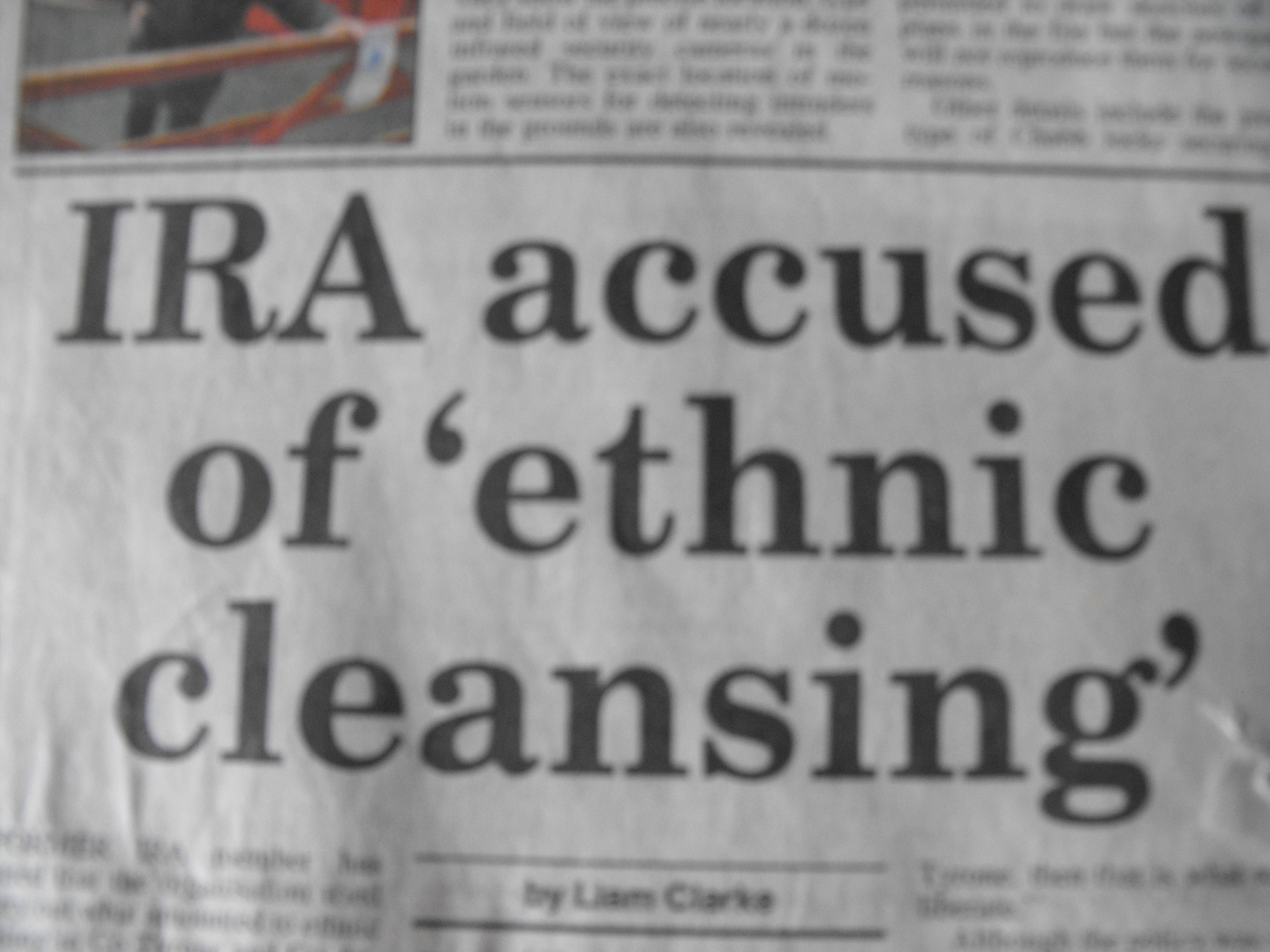
On the 29 March, 1998, I agreed to do a front page interview with Liam Clarke, for The Sunday Times, this at a time when Thomas 'Slab' Murphy, PIRA Chief of Staff, had taken a civil action against The Sunday Times in The High Court in Dublin. I explained how Martin McGuinness had sanctioned an official policy of Ethnic Cleansing in 1986. McGuinness was arrested by Gardai after this meeting in Monaghan in 1986, however, Gardai later advised me that MI6 had sought Martin's release without charge and Garda HQ had directed Gardai in Monaghan Town to release McGuinness.
Soon after my front page interview with The Sunday Times, an interview for which I was allegedly 'sentenced' to death by The PIRA Army Council, I entered Families Against Intimidation and Terror.
On April 17, 1998, rumors began to be directed from Sinn Fein/PIRA Informers and Rapists in Monaghan Town that I had sexually abused a child in Monaghan Town in the 1980s, these rumors picked up by Sinn Fein/PIRA Informers and Rapists in Belfast such as Dennis Donaldson, Freddie Scappitticci, Liam Adams and so forth, and feed to Sinn Fein/PIRA proxies in the media in order to shut down my exposing of Sinn Fein/PIRA's continued criminality.
Sinn Fein Press Statement, 1999, "At no time has Sinn Fein named Vincent McKenna as a suspect in relation to allegations of sexual abuse in Monaghan, such naming would deny such a suspect a fair trial"...https://www.anphoblacht.com/contents/5427
Following the ‘Secret’ Sinn Fein/PIRA Convention in Donegal in October, 1997, which voted to continue to back Gerry Adams and the fledgling peace process, Michael McKevitt who was PIRA Quarter-master on the PIRA Army Council and others walked away from the Adams Project.
Vincent McKenna Autobiography
When my cousin Seamus McKenna (Continuity IRA) told me that the Sinn Fein/PIRA Leadership were allowing McKevitt and others to empty PIRA arms dumps, I challenged my cousin, PIRA Chief of Staff, Kevin McKenna and Head of PIRA Northern Command, Martin McGuinness.
Kevin McKenna and Martin McGuinness were of one-mind:
“The odd bomb going off here and there will keep Unionists focused on working with the Doves”.
The Sinn Fein/PIRA Leadership had decided to use the Real IRA as Proxies to bomb Unionists into a power-sharing Executive at Stormont.
Following this duplicity, I walked away from my role in the peace process. I had worked for many years to bring about the surrender of the Provisional IRA and I was not going to support a process that would allow Terrorism to continue in any form.
War on Duplicity
Following my front-page interview with Liam Clarke for The Sunday Times, in which I explained how an official policy of Ethnic Cleansing had been operationalised by the Sinn Fein/PIRA Leadership in 1986, I was asked by Liam Clarke if I would go into FAIT as it was about to close.
I was reluctant to go into FAIT as a short time earlier, I had been threatened with legal action by FAIT when I had stated in The Irish News that FAIT was a front for Criminals. I contacted Garda Detective, Liam Donnelly in Monaghan and told him that I had been asked to go into FAIT, Garda Detective, Liam Donnelly told me to take up the offer as Sam Cushnahan was known to Garda Special Branch Officer, John McCoy and Cushnahan was believed to be associated with Loyalist terrorists who could pose a threat to the peace process and in particular with bomb attacks in The Irish Republic.
Letter published in The Irish News January 11, 1996.
Letter published in The Irish News, January 19, 1996.
I got back to Liam Clarke and told him that I would go into FAIT. I agreed to meet with Sam Cushnahan at the FAIT office on High Street. While Sam may have believed that everyone knew who he was, I had no clue. Sam told me that he knew that allegations had been made against me in Monaghan as Sinn Fein/Provisional IRA were using the allegations to discredit my work.
Sam Cushnahan told me not to worry about the allegations as he had been through the same thing himself, Sam claimed that a 12-year-old boy had threatened to report him (Sam) to the RUC for sexual abuse, Sam clinched his teeth and said he (the child) never got a chance.
As explained in this document, my focus and instruction, was to get on the inside of FAIT to establish certain facts about certain Terrorists who posed a threat to the peace process. While people believed that my high-profile work on continued violence was my primary objective, it was not, this campaign was useful to keep pressure on Sinn Fein/PIRA and their Proxies, however, my covert work was much more important.
At this time, 1998, Sam Cushnahan was facing bankruptcy, I helped him put a loan application together for 20K that would be co-signed by his brother John Cushnahan, John was a politician in The Irish Republic. As Sam began to confide in me more and more, and became more and more dependent on me for money, I would discover that Sam was in 1998 involved in two extra-marital affairs, one was with the mother of the 12-year-old boy who had committed ‘suicide’, I genuinely never established if Sam was involved with the mother before the child’s death or after.
Sam was also in a Homosexual relationship with a male Journalist in BBC NI, I know this, not simply because Sam told me, but because on one of the occasions Sam asked me for the ‘loan’ of some money to buy wine for his Mistress, I went with Sam to his Mistress’s house in East Belfast (I sat in the car) and Sam gave his Mistress the wine. Sam then drove to Linen-hall Street in Belfast to pick up his Homosexual partner, who had just finished his shift in BBC NI, all very weird. I would rather not name the Journalist as he was a married man at that time, or at least that is what Sam said.
Sam then set about telling me about brothels that he and senior loyalist paramilitaries were fronting. Sam said that FRU used the brothels to recruit sexual deviants within Sinn Fein/PIRA by covertly recording them with under-age boys/girls and so forth. I found the conversation bizarre.
Sam Cushnahan never paid Tax or VAT, but was never pursued.
Cushnahan said that a senior member of Sinn Fein/Provisional IRA and two loyalist paramilitaries had been involved in the running of one of his brothels on the Falls Road. The senior Sinn Fein/PIRA member was John Joe McGee, who Sam claimed was a British Agent. John Joe McGee would socialize with members of Sinn Fein/PIRA and then invite them to the brothel on the Falls Road. Once the Sinn Fein/PIRA members were recorded in compromising activity, they would be recruited by British Army Intelligence.
This brothel on the Falls road was a regular haunt for Gerry Adams Snr, Freddie Scappitticci, Ruby Davidson and a host of Sinn Fein/PIRA sexual deviants. As a result of the number of Sinn Fein/PIRA deviants recruited in this brothel and others operated by Cushnahan, the security services referred to the Sinn Fein/PIRA Leadership in Belfast as 'The Jocky Club'.
I honestly do not know how many calls I received from Sam Cushnahan begging me to go into FAIT, in the end I relented. I was the only person in the FAIT office, initially I spent my time going through any paper work I could find to establish where the money went and what was owed. I was Lecturing in Business part-time at this point in The Department of Continuing Education at QUB, so I had a good handle on accounts.
It is not unfair to say that a great deal of tax payers’ money (£1,000,000) had been squandered and the debts were insurmountable. As someone who had worked in factories up to 1992, I found this waste of tax payers’ money unforgivable.
As I had no money or resources, I used the only tool available to me, the media. As Sinn Fein/PIRA were hammering me in their own media outlets such as An Phoblacht and through some of their proxies, I hammered back, and this is where it got interesting.
Because people seen me standing up to the terrorists, and the terrorists hitting me hard, some disgruntled people within paramilitary groups began to contact me and provide me with information about planned terrorist attacks, weapons, explosives and so forth. While I had some contacts before 1998, this was a tsunami of information.
Following a high-profile attack on me 18 July 1998 by six members of Sinn Fein/PIRA Mark Sykes, Stephane Long, and so forth led by PIRA killer Sean Clinton, my kudos was boasted by those who sought a safe space to disclose information. One of my attackers pleaded guilty to assault in Court and the threat to kill was taken into consideration. The Sinn Fein/PIRA member who pleaded Guilty to assaulting me was accompanied to Court by Jock Davidson and others with whom a few months earlier I had been sharing a pot of tea.
I can say with confidence that some of this information, and the related action by the RUC, saved the peace process and the Good Friday Agreement and that is why I shared a public platform in The Ulster Hall and thanked the RUC in 1999. In fairness to those attacking me, they did not know that they owed their lives to the RUC and that includes senior Sinn Fein/PIRA and others who would jump in front of cameras to try and discredit me, not knowing that my work had saved them and their families.
The suspicions highlighted by my Garda contact that FAIT was being used by extreme loyalist elements connected with Sam Cushnahan, who were not only trying to undermine the peace process but also running black propaganda against PUP/UDP were well founded.
Plans by some to plant no-warning bombs in Dublin and Monaghan once again 1998-99, were prevented by the information I gleamed from my time in FAIT and later Northern Ireland Human Rights Bureau which I set-up purely to maintain contact with valuable informants, it was essential that the ‘intelligence’ aspect of my work was removed from FAIT or many people could have died. I can prove all of this.
When the LVF/Orange Volunteers murdered Solicitor, Rosemary Nelson, Sam Cushnahan wanted me to issue an outrageous press release, which suggested that some markings that Rosemary Nelson had on her face, throughout her life, were the result of a bomb she was making some years earlier exploding prematurely. While I was trying to maintain my intelligence role, I refused outright to issue such a press release.
Over the few months that I managed to tolerate Sam Cushnahan, I gleamed a great deal of information about his personal life and criminal activity, in which I had no particular interest.
Sam had been involved in Kincora Boys home, that involvement began when he was laying down carpet in the home, he spoke to me openly about all of this, as if I were someone who would tolerate such criminality. Sam Cushnahan stated that his helper at Kincora, also from the lower Falls was Gerry Adams Snr, and both of them had sexually abused children in Kincora, although he did not use the word ‘abused’.
Sam told me that he had been in the merchant navy, and when he ‘retired’ from that he was involved in criminality with James Craig, although he told this as if it was nothing, as if he was Arthur Daly out of Minder, wheeler and dealer. He had been involved in break-ins, stolen property and acted as a fence. He also said he was caught red-handed, when he burned a building to get the insurance, but again he knew the right people, again this Mantra about the ‘right people’ came up time and again.
Sam Cushnahan told me that he had begun his career in the brothel business with a Pimp called Bernie Silvers and later Sam was in a sexual relationship with a Mr Francis with whom he operated a Brothel on Stranmillis Road in Belfast. The women and girls in these Brothels were referred to by Sam as his ‘Girls’ and they in turn referred to him as ‘Sammy’, a well know female in Northern Ireland was the Madame in his Brothels before she reinvented herself.
Interestingly, Monica McWilliams of The Northern Ireland Women's Coalition sought a meeting with Sam and I, I had no interest in meeting McWilliams as I viewed her as a "Powder-Puff Provo". Sam and I meet with McWilliams at her office in Stormont, a good friend of mine Kate Ferron, whom I knew from QUB showed us into McWilliam's office. Monica McWilliams welcomed Sam with an embrace and referred to him as "Sammy".
Monica McWilliams became fixated on me once I walked away from FAIT and Sam Cushnahan, I had to report Monica McWilliams to the PSNI for Stalking me on Social Media in 2023.
When I closed FAIT, Sam realised he had said too much and he and the Madame set about trying to discredit me, as they had done to Nancy Gracey, Glynn Roberts, and others over the history of FAIT. It is worth noting, that Spotlight, BBC NI, only set about trying to discredit me when I left FAIT and parted company with Sam Cushnahan, before this, when I was in FAIT, BBC NI supported my work.
In this Newsletter article, Sam Cushnahan claims that porn had been found on the FAIT computer after Glynn Roberts had left FAIT in order to discredit Glynn. In fact it was Sam who had planted to the porn to discredit Glynn. Glynn had done no wrong. In 2000, Susan McKay would claim in an article in The Sunday Tribune that porn had been found on the FAIT computer while I was there, however, Susan McKay knew well the porn referred to was found long before I went near FAIT, McKay, a liar and fraudster, now the Press Ombudsman in The Republic.
However, I had no interest in them or their sordid life style, I was interested in preventing murder and saving the peace process and I can easily prove that I done this.
Sam Cushnahan constantly talked about knowing the right people, yet, any RUC Officer that I spoke to wanted nothing to do with him, it was as if there was something in the background that I did not know about, the main objective was achieved, and then I spoke to The NIO, Billy Stevenson, to ensure no further funding for FAIT, I closed it down, and I continued to work on a voluntary basis nurturing and maintaining new intelligence assets within The Northern Ireland Human Rights Bureau.
While I was in prison in The Republic, I received letters from a journalist called Frank Doherty, whom I did not know. In the letters Frank said that he had seen ‘The Bank Statement’ relating to a £2,000 payment made to FAIT by RUC Informer, Martin McGartland. When I was released from Prison, I meet Frank Doherty in Drogheda, my only interest was to establish where he got McGartland’s details.
Frank Doherty told me that Sam Cushnahan had given him McGartland’s details prior to McGartland being shot as Sam wanted to be at the centre of a book that Frank was writing about various matters relating to Northern Ireland.
I am aware that McGartland issued a press release after he was shot claiming that I was an active PIRA Intelligence Officer, this press release shown to me by Mr Hugh Jordan of The Sunday World. On the basis of McGartland’s lies, I was questioned at Castlereagh RUC station for several hours.
I can say with certainty, it was Sam Cushnahan who not only leaked McGartland’s details, but got paid for such leaking. I believe it was Sam Cushnahan who set-up McGartland, and was able to do so because of McGartland’s passing his own information by way of a bank statement. I have supporting evidence that Sam Cushnahan had previously sent a come-on letter to British Army Captain, Fred Holroyd, who served with MI6 in Northern Ireland in the 1970s. The letter was to lure Holroyd to an address in Belfast. Holroyd was to be murdered by loyalists, and the blame placed on The PIRA.
Conclusion
In conclusion, it is not unfair to say, that nobody could have envisaged the amount of Intelligence that I would gain from entering FAIT and later creating The Northern Ireland Human Rights Bureau. Scores of lives were saved, bomb attacks prevented, and the fledgling peace process got a chance to deliver, in my view it did not deliver, and my explanation for this determination can be viewed in the Omagh Bomb Blog Post.
Personal Political Background
This submission and factual history has been prepared by Vincent McKenna BSSc PGDipSSc MSc. Certified Digital Marketing Professional.
My Paternal family history can be traced directly to McKenna Clan Chieftain, Patrick McKenna, who sat at The Hill Of Tara in County Meath in the seventeenth century. Patrick's son Niall McKenna would in 1641 slaughter over 2,000 Protestants in the Northern counties. Plans by the British to retaliate for this slaughter was delayed by the English Civil War, however, Oliver Cromwell administered that retaliation in 1648.
My Great Aunt Kathleen McKenna, was in 1921, Private Secretary to Sinn Fein Leaders Arthur Griffith and IRA Leader, Michael Collins. Kathleen died in 1988, and I was able to speak with Kathleen on her return to Ireland and before her death. My loyalty has been to The Irish Republic created by my Great Aunt Kathleen. Kathleen was non-sectarian and viewed Provisional IRA/Sinn Fein as sectarian bigots.
Kathleen McKenna travelling to London with Sinn Fein Leader, Arthur Griffith to sign the Treaty.
Between 1982-84, I was introduced to and meet with on a number of occasions, Sean McBride SC who had been Chief of Staff IRA, 1936-37. I had been introduced to Sean McBride SC at The four Courts by Paul Callan SC who was representing me in an extradition case. Sean McBride SC had a domestic and international political reputation and would be awarded the Nobel Peace Prize.
Sean McBride SC who had been anti-Treaty in 1921, was of the same mind as my Aunt Kathleen McKenna in the 1980s, Provisional IRA/Sinn Fein were sectarian bigots.
I was sworn into The Provisional IRA in 1980 when I was 16-years-old by my cousin, Kevin McKenna (PIRA Chief of Staff, 1983-1997). I would be Kevin McKenna's eyes and ears within Sinn Fein/Provisional IRA in Monaghan Town. Kevin McKenna lived in Smithborough, County Monaghan.
As members of Sinn Fein/Provisional IRA talked-out-of-shop to me they would not have known how close I was to Kevin McKenna.
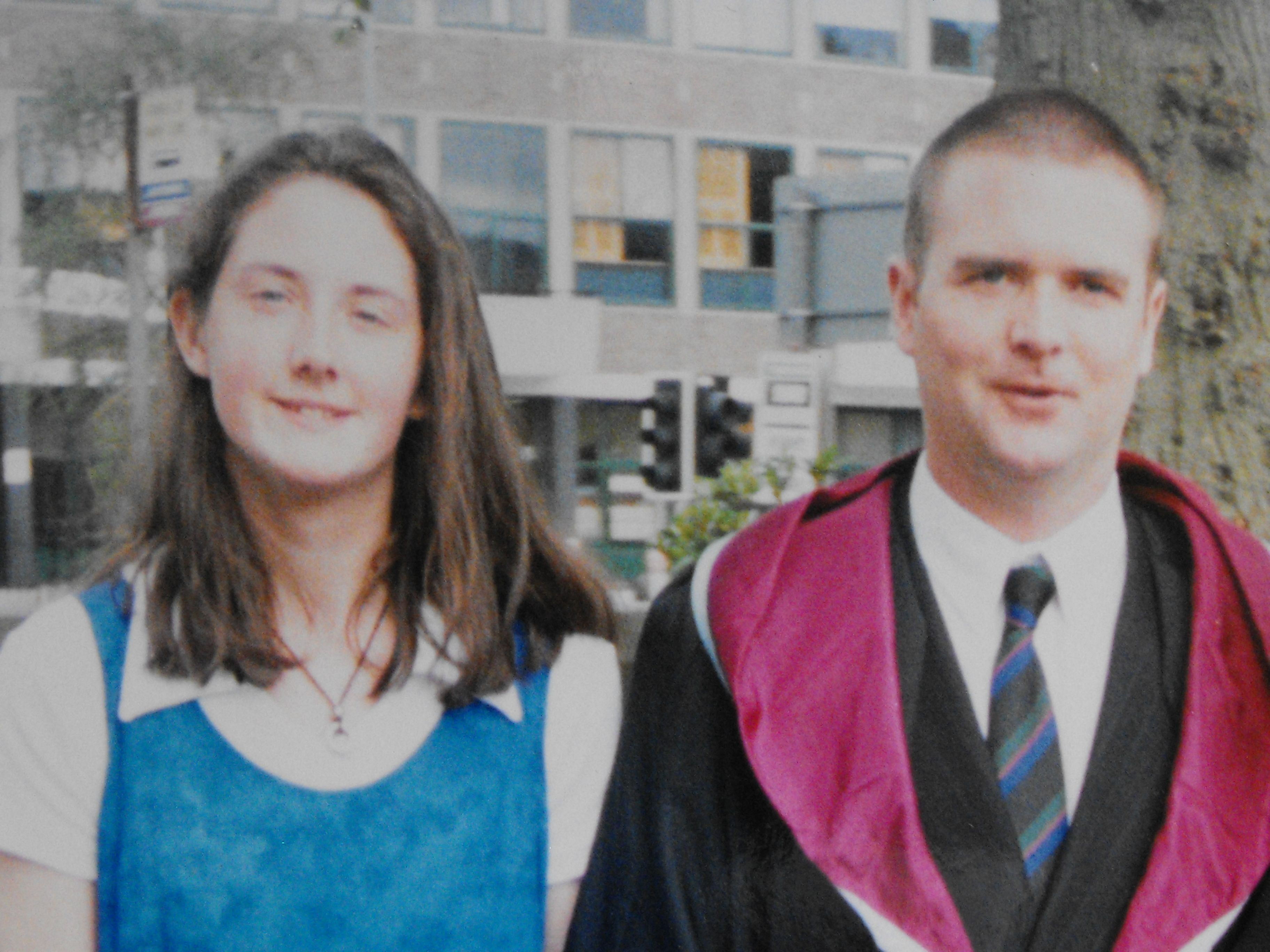
I am far left in this picture with John Hume MEP right 1994. I was working with John Hume from 1992 and created early drafts of what would be come known as The Good Friday Agreement. Between 1996-98, I worked on the final draft of The Good Friday Agreement.
I stepped away from the Good Friday Agreement when Kevin McKenna and Martin McGuinness admitted to me that they were arming The Real IRA to use as Proxies, this duplicity, had been used by Sinn Fein/Provisional IRA many times before.
Republican Action Force was the name used by The Provisional IRA when they murdered 10 innocent Protestants in Kingsmill in 1976, I know this because my cousin Sean McKenna was one of the gunmen, and I spent many months with Sean as he recorded his life story.
Direct Action Against Drugs was set-up by the Sinn Fein/PIRA Leadership in Belfast to take protection money from drug dealers. I know this, as Jock Davidson was my main Provisional IRA contact in the Markets/Shortstrand/Lower Ormeau Road area in Belfast for a number of years in the 1990s.
Kevin McKenna had been known to me from the time I was a small child, when Kevin would cycle into Aughnacloy and Kevin would take me on the crossbar of his bike to my grandparents house in Coronation Park.
In 1981, I had graduated from Na Fianna Eireann to working on Internal Security with JB O'Hagan, the PIRA member in uniform front left was dismissed from The PIRA because of my evidence to The PIRA Command Staff. For example, this PIRA member told me about certain matters that placed men and equipment at risk.

Caoimhghín Ó Caoláin TD swore me into Sinn Fein/PIRA at a meeting attended by JB O'Hagan, Kieran Starr's and Padraigin Ui Mhurchadha (sister of Fergal O'Hanlon, shot dead 1957). I do not think that Caoimhghín Ó Caoláin ever knew that I was close to Kevin McKenna.
In this picture Caoimhghín Ó Caoláin beneath the black flag with pick-axe handle raised above his head as protesters attack Gardai during a Hunger-strike march in Dublin in 1981. Before we left Monaghan that morning members of Sinn Fein/PIRA purchased dozens of Pick-axe handles from Patton's Hardware store in Monaghan Town to attack Gardai. It was hoped we would reach the British Embassy and burn it to the ground as was done following Bloody-Sunday. In this picture, Omagh Bomber, Seamus McKenna (black leather jacket) can be seen calling up those with the petrol bombs, to try and breach Garda lines.

I am in the picture below 1981 on the left carrying a symbolic coffin in Monaghan Town to commemorate the death of PIRA Hunger-striker, Kieran Doherty TD. We are all in-step to commands being shouted in Gaelic, I had learnt these commands in Na Fianna Eireann. This picture was reproduced in An Phoblacht in 2013 for a National Hunger-strike commemoration. In 2013, I was back on the inside of Sinn Fein/PIRA in Dublin and helping to develop their Information Technology systems.
My main contact 2013-2015 was Bobby Storey, I parted company with Bobby again when he admitted the Provisional IRA Army Council including Bobby had sanctioned the murder of Kevin McGuigan in Belfast.
I am encircled in the picture below behind to the left of John 'Dinger' Bell, I and others were to open a corridor through the crowd to get the PIRA gunmen up an entry and into the back of a house previously rented by one of the gunmen.
The weapons and uniforms were to be moved in two Hi-ace Vans, one driven by Malachy Toal and the other by Patrick McKenna. Garda officers tried to block the exist of the two vans and the Garda car was over-turned into a ditch.
Garda Detective, Joe Derwin opened fire with an Uzi-sub-machine gun and later a revolver. With their backs to the camera are PIRA Laurence McKenna (sentenced to 5-years for this incident) and Laurence McNally (shot dead by SAS 1991). Laurence McNally, Laurence McKenna and I confronted Joe Derwin, in order to prevent mourners being shot.
Two of the PIRA gunmen, Cathal and John would not be known as PIRA outside Sinn Fein/PIRA. The OC, facing the camera, John 'Dinger' Bell.
The Plan to Murder Gerry Adams
Background
From the outset of the sectarian conflict in Northern Ireland, be that The IRA Border Campaign 1957-62 or the retraining and restructuring of The IRA 1962-66, there were constant efforts made by both the British and Irish Governments to maintain ‘peace’ within a Law and Order rather than a Social Reform framework.
It is clear from the evidence of State papers released in The Irish Republic that the IRA was ready and preparing for a fresh campaign of sectarian violence. My own knowledge of this IRA preparedness in the 1960s, is boosted by my association with 1960s IRA men, Ruairí Ó Brádaigh, Joe Cahill, JB O’Hagan, Vincent Conlon and so forth in the 1980s, when they were leading The Provisional IRA.
While it is often stated that the sectarian conflict in Northern Ireland began for real with a Civil Rights March in Derry in October, 1968, a march baton charged by the RUC. This Civil Rights March followed by the creation of The People’s Democracy at Queens University, Belfast by Bernadette McAliskey (nee, Devlin), this is not the case.
In the summer of 1968, while I was 5-years-old, a paternal relative of mine, who was living in Caledon, County Tyrone, assisted nationalist politician, Austin Currie, and two members of the IRA Patsy Gildernew and Joe Campbell to break into and squat in a vacant house.
Left to Right: Patsy Gildernew, Austin Currie and Joe Campbell
This in protest at the allocation of the house to a single Protestant woman and not to Patsy Gildernew and his family. In the 1980s Joe Campbell was living in Monaghan Town and sharing a house with PIRA Army Council member, JB O’Hagan.
Joe Campbell, said, “While the local council provided the opportunity in 1968, we in The IRA exploited that opportunity”
Joe Campbell in front of man with child at IRA march in Monaghan Town, 1981.
This allocation process, appeared to favor Protestants over Catholics, particularly when individuals could be identified as having connections with Unionist Politicians. However, in Monaghan Town, in 1982, I was married with one child, and a Fianna Fail Councilor, Edmund Burke told me I could have one of the new council houses on Cortolvin Road, if I would vote for Fianna Fail in the election that year. I declined the offer, and was eventually granted a house in the less sought after, Mullaghmatt Council Housing estate in Monaghan.
I can also say that many hundreds of my paternal, and to a lesser degree, maternal families, moved from The Irish Republic to Northern Ireland in the 1950s/60s to enjoy the benefits of council houses that had electricity, running water and a sewerage system, while a few hundred yards away in north Monaghan, families lived without what where being described in Northern Ireland as basic Civil Rights.
The point I make above, from real life experience, is that political allocation of houses and jobs, was not exclusive to Northern Ireland, and social depravation and disenfranchisement was much more common in The Irish Republic.
Hensey McKenna Death
In the 1960s it would have been difficult for any Irish Government to demand a certain standard of living and freedoms in Northern Ireland when the same standard of living and freedoms were not available to the majority of people in The Irish Republic.
Dublin, 1968, hundreds of thousands lived in slums, hundreds of thousands disenfranchised.
When Jack Lynch became Taoiseach, 1966, he was given an assessment of The IRA by then Secretary of The Department of Justice, Peter Berry, for Lynch’s first meeting with British Prime Minister, Harold Wilson.
Peter Berry explained to Jack Lynch that up to one-thousand men, women and children were under the command of The IRA Army Council, this was an increase from the estimate of six-hundred-fifty in 1962 when the failed IRA Border Campaign was halted.
Peter Berry further reported that The IRA had been involved in drilling and arms training since its announced cessation in 1962. While The IRA were numerically strong, they lacked the finances for any sustained campaign of violence and Peter Berry was also aware of Communist leanings by some of The IRA leadership.
Peter Berry concluded in his assessment of The IRA, that, any number of sparks could be used by The IRA to light a fresh campaign of sectarian violence.
When the sectarian conflict began for real, there were many efforts by many stake-holders to end the violence. In my own estimation, the British Foreign Office through MI6 were in contact with The Provisional IRA Army Council from the outset.
The British Government also used the British Embassy in Dublin to built a relationship with the Irish Government, with varying degrees of success.
I do not support the view of many, that MI5, RUC Special Branch, British Military Intelligence and The NIO were opposed to any dealings with The Provisional IRA. All of these stake-holders were simply more cautious in their dealings with Sinn Fein/Provisional IRA as they knew them on the coal-face, not from behind a desk in Whitehall.
All of that said, there remains key question marks over the role of MI6 Officer, Michael Oatley and his dealings with Martin McGuinness. The complexity of this relationship, is captured in the 1993 Communication from Oatley to McGuinness.
In the 1993 Communication from MI6 Officer, Michael Oatley to Martin McGuinness, Oatley signs off with: (see, Exhibit 1).
“I hope you will not mind me ending with a new meaning to Tiocfaidh ár lá (Our Day will Come).”
NOTE: This Communication was initially hand-written by Michael Oatley and addressed to Martin McGuinness. However, Officer, Robert (see, initial) typed up the Communication in order to remove Martin McGuinness’s name from the top of the document and Michael Oatley’s from the bottom. Surely, if McGuinness was acting on behalf of Sinn Fein/Provisional IRA there should have been no fear of disclosure.
Robert was an MI5 Officer who meet with Martin McGuinness and Gerry Kelly MLA within days of the 20 March, 1993, Warrington Bomb attack in England in which two children were murdered. It was at this meeting that Robert gave Martin McGuinness the Communication from MI6 Officer, Michael Oatley, however, Gerry Kelly MLA was not made aware of this Communication by either Robert or McGuinness.
Communication, 1993, from MI6 Officer, Michael Oatley, to MI6 Agent, Martin McGuinness.
It was this 20 March, 1993 indiscriminate litter-bin bombing in Warrington that certain loyalists hoped to replicate in Dublin and Monaghan in 1998, however, I was lucky to be in a position to prevent the bomb attacks in Dublin and Monaghan.
Tiocfaidh ár lá in Sinn Fein/Provisional IRA parlance means a continued armed campaign until such time as a United Ireland free from British interference is achieved.
So, what is the “new meaning” that MI6 Officer Oatley is referring to? The surrender of The Provisional IRA, the removal of The Irish Republic’s claim over Northern Ireland, as then contained, in Articles 2 and 3 of Bunreacht na hEireann (Irish Constitution) and an acknowledgment by Sinn Fein/Provisional IRA that Northern Ireland is an integral part of The United Kingdom by Sinn Fein/Provisional IRA administering British Rule from Stormont.
This Counter-Republic, achieved by Agents of Influence, is certainly a desirable out-come for the British.
Whatever, the “new meaning” alluded to by Oatley, it is clear that the relationship between Oatley and McGuinness was not one of McGuinness being a negotiator on behalf of Sinn Fein/Provisional IRA and Oatley being a messenger to the British Government.
MI6 Officer, Michael Oatley also profiteered from his relationship with Martin McGuinness and Property Developer, Brendan Duddy. Duddy had claimed that he was the middleman between MI6 and Martin McGuinness, however, it is clear from Oatley’s communication to McGuinness in 1993, that no middleman was required for much of their relationship.
Michael Oatley, Somerset, England, was listed at Companies House as a director of the Strand Hotel/Holiday Inn Express Derry-Londonderry from 2015 until October, 2018. Oatley had built up a substantial business portfolio in Northern Ireland while working with Martin McGuinness and Brendan Duddy.
MI6 attempted to recruit me on two occasions, 1995 in Cambridge and 1999 in London. The 1999 encounter was the most telling, as the MI6 Officers, had no concern about the fact that Kevin McKenna and Martin McGuinness had armed the Real IRA. It would not be unfair to say that MI6 held the same view as Kevin McKenna and Martin McGuinness:
“The odd bomb going off here and there will help keep Unionists focused on working with the ‘Doves’”.
Such a view could easily be understood within a certain set of circumstances, however, can such a view be justified when those bombs deliver mass-murder, intentional or not, as happened in Omagh 15 August, 1998. There is an intrinsic moral culpability and potential for harm as encouragement, for those who would carry out acts of terrorism.
It can certainly be said that in the absence of the full facts in 1998 which lead to the Omagh Bomb, the Omagh Bomb and its aftermath were used as leverage to nudge unionists into power-sharing with Sinn Fein/Provisional IRA.
However, it is my view, from real-time operational experience, that as late as 1999, MI6 knew virtually nothing about the operational capacity of the Real/Continuity IRA, and I am not sure they were too bothered. MI6 offered me money, which would be funneled to me through a Manchester based businessman, and if the money was discovered, the businessman would say he was funding my peace work. I declined the MI6 offer in 1995 in Cambridge and I declined the MI6 offer in 1999 in London.
MI6 told me they had funneled money to Bertie Ahern in exactly the same way. Bertie Ahern, while before The Mahon Tribunal on political corruption many years later, would try and explain away large amounts of Sterling (English money) he received in the 1990s by saying he had won the money on the horses.
MI6 had achieved their objective as directed by The Foreign Office, which was the removal or dilution of Articles 2 and 3 of Bunreacht na hEireann (The Irish Constitution) that laid claim to Northern Ireland. MI6 had secured the agreement of The Irish Government and Sinn Fein/PIRA to that dilution or removal and which was then ratified by Referendum in The Irish Republic.
John Taylor MP who was a key Unionist negotiator at the talks leading to The Good Friday Agreement, said:
"At the talks leading to the Belfast Agreement both the Republic of Ireland Government and Sinn Fein agreed to The Republic of Ireland abandoning its claim over Jurisdiction of Northern Ireland. They therefore agreed to the abandonment of Articles 2 and 3 and recognised Northern Ireland as part of The UK. The people of the Irish Republic agreed in referendum." (Twitter, 17 February, 2023).
From a security point of view the operational capacity of Sinn Fein/PIRA was left to The RUC, MI5 and An Garda Siochana. The London and Dublin Governments were not losing any sleep due to the continued gangland criminality of Sinn Fein/PIRA and Others. Such gangland criminality viewed by both Governments as "Internal House-keeping" and not breaches of their Articles of Surrender.
From my own knowledge of the RUC (and by definition MI5) cooperating with An Garda Siochana, significant numbers of operations that could have completely derailed the 'peace process' were prevented. The only significant departure from this cooperation, was Banbridge and Omagh. This departure explained in this submission.
Banbridge and Omagh Bombs
On 4 July, 1998, I received a phone call from my cousin Seamus McKenna. In 1998, Seamus McKenna was working within a tight circle of Real IRA and Continuity IRA members who were mainly based in County Louth and to be found socialising in the Emerald Bar in Dundalk owned by Colm Murphy.
Seamus McKenna was well known to me since I was a small child. I would as a child visit my Uncle Sean's house in Newry (These visits referenced in Sean McKenna Jnr Biography) with my Father, Grand-father and Great-Grand-Father. During my Uncle Sean's funeral in 1975, I had stayed in my Uncle Sean's house in Newry for his wake.
In later years, when I had moved to Monaghan Town, my cousin Seamus would visit me. Seamus McKenna had extreme loyalty to me, as I had also taken care of his brother, Sean McKenna Jnr (PIRA Hunger-striker, 1980) when Sean was released from Long Kesh (The Maze Prison). Seamus would often talk about his Father, Sean McKenna Snr who had died as a result of the torture he had been subjected to during Internment.
Seamus always wanted me to know that he was still fighting in order to punish the Brits for what they had done to his Father. Seamus always spoke openly to me about what he was doing.
Seamus told me on the 4 July, 1998 that the Real IRA were going to bomb Banbridge and Omagh. I passed over what Seamus said and did not draw too much attention to it, because if Seamus thought I was trying to get information, rather than him giving information, he would simply say “Fuck Off”. I reminded Seamus about a time was I was placed in a cell in Omagh Court House and there was no back wall in the cell as PIRA had blown it up a short time before.
As soon as I finished my phone call with Seamus 4 July, 1998, I immediately phoned a Garda Special Branch Officer, Liam Donnelly, in Monaghan Town, whom I had known for some years. I told Liam Donnelly, what Seamus had said, and he said he would pass it on and get back to me.
Note: Garda Detective, Christy McNamee, known to me from 1980, who had retired, was in the 1990s working as a Private Detective. I had employed Christy as a Private Detective in relation to a number of matters. Garda Detective, Liam Donnelly, while employed by An Garda Siochana was doing freelance work with Christy McNamee, it was Christy who introduced me to Liam Donnelly.
On Monday 6 July, 1998, my Garda contact, Liam Donnelly, phoned me and asked if I would meet with someone from Dublin who wanted a face to face. It just so happened that I had been invited to a function at Áras an Uachtaráin, the home of The Irish President, Mary McAleese, 11 July, 1998. I told my Garda contact Liam Donnelly that I would meet his contact at Áras an Uachtaráin on the 11 July, 1998.
When I arrived at Áras an Uachtaráin on the 11 July, 1998 in the company of three others, who did not know my mission, we were welcomed by Mary McAleese and her husband Martin. Mary McAleese was known to me, as she had attended some of my peace work at Queens University in Belfast, when she was lecturing at QUB and I was a student.
When I received a call on my mobile phone, I excused myself from my company, and went to a side room of the main room where the function was taking place.
NOTE: In 1998, mobile phones were not as widely available as today, however, I had been employed by a Market Research Company called 'High Fliers' (Cambridge) to carryout Graduate Research at Queens University, when my Graduate Research was complete, High Fliers, allowed me to keep the mobile phone they had supplied to me for the Research.
I repeated at Áras an Uachtaráin to a senior Garda Officer what my cousin Seamus McKenna told me about Banbridge and Omagh, and I made it absolutely clear that I wanted Michael McKevitt, Bernadette McKevitt Sands, Seamus McGrane, Liam Campbell, Colm Murphy, Seamus Daly and Seamus McKenna arrested and taken out of circulation.
When I left Áras an Uachtaráin in the early hours of 12 July, 1998, I was satisfied that both the Banbridge and Omagh bombs would be stopped. As we prepared to leave Áras an Uachtaráin in the early hours of 12 July, 1998, a dark shadow had fallen upon us, as we received news that three children had just been burned to death in an apparent sectarian attack in Ballymoney.
Letter Ref: JDM/dh, dated 30 September, 1998, signed by Solicitor, Jason McCue working for Henry Hepworth, London, to Vincent McKenna.
Faxed again to Vincent McKenna from: Henry Hepworth – 0171-242-7998 on 3 December, 1998.
The letter explains that on dates including, July 14, 1998, I was a significant witness against Provisional IRA Chief of Staff, Thomas ‘Slab’ Murphy. I was a witness as I hoped that exposing the personal fortunes accumulated by Leadership members of Sinn Fein/PIRA would discourage lower ranking Sinn Fein/PIRA members from continuing to support acts of violence in the name of the 'cause’.
Following my disclosures at Aras an Uachtarain, 11 July, 1998, about the Banbridge and Omagh Bombs, I was asked to give sworn testimony in a closed Court setting, in order to prepare for the arrests of the Real IRA Leadership by Warrant. The date for this closed Court clashed with the date for me to give evidence against Thomas ‘Slab’ Murphy.
The Judge presiding at the closed Court hearing wanted an explanation as to why I was absent from the closed Court hearing, but did attend on another day, hence the letter from Jason McCue.
In the end, none of the above mattered as Bertie Ahern Directed the Garda Commissioner, not to arrest the Real IRA Leadership, prior to the Banbridge and Omagh Bombings.
On the 18 July, 1998, I was assaulted in Belfast by six members of Sinn Fein/Provisional IRA led by Provisional IRA killer, Sean Clinton. One Sinn Fein/PIRA member would plead guilty in Court to this assault and the threat to kill was left on the books by agreement with me. The PIRA members had not done their homework, I had just won a Silver Medal in The UK Regional Martial Arts Championship.
A few hours after I was assaulted a Sinn Fein/PIRA gang murdered Andrew Kearney in Belfast, Andrew's alleged crime was that he protected a child from assault at the hands of a local Sinn Fein/PIRA gang leader. Sinn Fein/PIRA continued murdering, mutilating, exiling and raping as Mo Mowlam had assured the Sinn Fein/PIRA Leadership that the RUC would not intervene.
Attacks on Mickey Donnelly (CIRA) in Derry and Kevin McQuillan (IRSP) in Belfast by Sinn Fein/PIRA, would result in Joe O'Neil (CIRA) in Donegal dispatching a no-warning 500lb car bomb to Connolly House in Belfast to wipe-out the Sinn Fein/PIRA leadership, however the bomb was intercepted at the Donegal border, as I had been tipped-off by my cousin Seamus McKenna. Gardai would say that the bomb was on its way to a commercial target, however, this was to prevent retaliatory action by Sinn Fein/PIRA.
Sinn Fein/PIRA did in early 2000 plant a bomb at Republican Sinn Fein Offices in Belfast as Republican Sinn Fein Leader, Ruairi O Bradaigh, was to officially open that office, however, a member of the public discovered the bomb and Sinn Fein/PIRA had to cover their tracks by disposing the bomb themselves. I do not know if Sinn Fein/PIRA ever knew about the bomb dispatched by Joe O'Neil.
When the Banbridge Bomb exploded 1 August, 1998, I phoned Garda Detective, Liam Donnelly, and asked him why Michael McKevitt and the bombers had not been arrested, he had no explanation other than the decision was taken in Dublin. I told him that I might have been better going to the media, and he said, “Jesus don’t do that”.
Following the Banbridge Bomb my cousin Seamus McKenna phoned me again and sounded disturbed about the fact that so many civilians had been injured. Seamus talked about the on-going plan to bomb Omagh, Seamus said that there had been a meeting between Michael McKevitt, Bernadette McKevitt Sands and Irish Government officials before Banbridge.
I am satisfied that the meeting between Irish Government officials and the Real IRA before Banbridge was as a direct result of my meeting at Áras an Uachtaráin 11 July, 1998 and my insistence that the Real IRA Leadership be arrested.
Minister for Justice, John O'Donoghue TD while visiting me in Wheatfield Prison in early 2001, confirmed to me that he and Bertie Ahern had sent Dr Martin Mensergh to meet with The Real IRA following my tip-off, 11 July, 1998. According to John O'Donoghue TD the Government did not want to undermine Gerry Adams and Martin McGuinness by arresting the sister of Bobby Sands, shortly after signing The Good Friday Agreement.
Between 2010-2011, I was close to Bernadette McKevitt-Sands and she confirmed that the meeting between Dr Martin Mensergh and the Real IRA was before Banbridge, and Mansergh had made it clear that the Government knew the Real IRA were planning a fresh bombing campaign.
Bernadette confirmed that in the aftermath of Omagh, Dr Mansergh meet with the Real IRA Leadership again and offered a full-amnesty in relation to Omagh if the Real IRA would disband. The Intel Report below was submitted by me, six-weeks before Paddy Dixon was blown up in Navan in 2011, with a booby-trap bomb.
In 2011, Bernadette McKevitt-Sands, was working in Navan, Paddy Dixon and I, were living in Navan, County Meath.
In the aftermath of the Omagh Bomb, I was able to prevent further Bomb attacks that were being directed by the Leadership of Real/Continuity IRA. My source for this information was Seamus McKenna and specifically related to the 500lb bomb destined for the residence of The Secretary of State in Northern Ireland, Peter Mandelson and the bomb dispatched by Joe O'Neil to bomb Connolly House in west Belfast.
The difference between these two bombs being stopped and the Banbridge and Omagh Bombs being allowed to run, was the fact that I provided the information about the Mandelson and O'Neil bombs to the RUC, not An Garda Siochana. As the Mandelson bombers were being arrested, an RUC officer phoned me and thanked me for providing information that prevented the bombing.
This is an original part of an Intel Report in which I identified the location of one of the bombers. The RUC had absolutely no clue that this individual was a terrorist until I identified him as such.
The London bomb team including Queen's University student, Darren Mulholland, who was known to Seamus McKenna in Dundalk and I at QUB, was also arrested in 1998 based on my information. However, unlike the Banbridge and Omagh bombs, An Garda Siochana shared my information with MI5. At QUB Freshers week in the Autumn of 1998, Sinn Fein/PIRA personnel were again recruiting students for a bombing campaign in England, Sean, Kevin and Mark were named publicly by me as the PIRA recruiters.
BBC Spotlight would later state that I had lied about students being recruited for a bombing campaign in England, even though the student bombers had been arrested with semtex before the program was aired. It may be the case that 'dark forces' and their proxies in the media had wanted the bomb attacks to go ahead, however, my going public had prevented the attacks.
I had also prevented attacks on leading members of Sinn Fein/PIRA in Belfast and bomb attacks in The Irish Republic, these were planned loyalist attacks, however, I cannot at this time name the informants, as one at least is still alive. Gerry Adams and Caoimhghin O'Caolain were only made aware of this aspect of my work in 2018.
In 2019, I meet Bertie Ahern at a function in north Dublin, and Bertie Ahern confirmed that he had directed Garda Commissioner, Pat Byrne, not to arrest the Real IRA Leadership prior to the Banbridge and Omagh Bombs, as he was taking his direction about the Real IRA from Phil Flynn, Gerry Adams, Martin McGuinness and Caoimhghin O'Caolain.
Bertie Ahern with PIRA Army Council members, Gerry Adams, Martin McGuinness and Martin Ferris.
Bertie had chosen to send Dr Martin Mensergh to talk to the Real IRA. Bertie said that Phil Flynn, Gerry Adams, Martin McGuinness and Caoimhghin O'Caolain, described Bernadette-McKevitt-Sands in particular, as republican royalty, and her arrest with her husband Michael McKevitt could undermine Adams and McGuinness on their home ground where there was strong opposition to The Good Friday Agreement. This opposition, manifested in brutal attacks by Sinn Fein/PIRA on Kevin McQuillan in Belfast and Mickey Donnelly in Derry City.
Seamus McKenna said the Court House in Omagh was going to be bombed on Saturday the 15 of August, 1998, he was not happy about it, but what could he do.
I phoned Garda Detective, Liam Donnelly in Monaghan and updated him on what Seamus had said about the plan to bomb Omagh Court House on the 15 August, 1998. Garda Detective Liam Donnelly assured me that the bomb would be stopped and to say nothing to anyone else. I made a note in my 1998 diary, this diary has been seen by senior police officers. I have been a prolific diarist from 1980.
On Saturday 15 August, 1998, I was in Portrush in a mobile home and listening to the radio expecting to hear that the bomb had been stopped on its way to Omagh, when news of the bomb exploding came on the radio, it put me to my knees. I could not believe that the bomb had not been intercepted. I phoned Garda Detective Liam Donnelly, he had no explanation other than the decision was taken in Dublin, and he sounded like he was under pressure.I then phoned renowned journalist Barrie Penrose with whom I was working on the, Thomas 'Slab' Murphy case, at that time and I put on record with Barrie everything that had happened over the previous weeks including the names I had given to the Irish authorities.
I also got a bus to Belfast, left my partner and children in Portrush, and briefed a couple of trusted journalists as I believed the truth about Omagh would never be told.
The Omagh Bomb became very personal for me, when it became clear that Avril Monaghan, Avril's mother, Mary, Avril's little daughter Maura and Avril's unborn twins were all murdered. Avril's husband Michael and his brother Dermot were school friends of mine, we had played GAA together at St Ciaran's Secondary school in Ballygawley and in our local clubs of Aughaloo and Augher.
My cousins Willie, Eugene and Dessie McKenna had a small pub in Augher close to Monaghan's pub and I had played darts in both bars many times over many years, this was a small rural community ripped apart in Omagh on the 15 August, 1998.
In 1998, in the immediate aftermath of the Omagh Bomb when I publicly criticised Bertie Ahern and John O’Donoghue for directing Garda Commissioner, Pat Byrne, not to arrest the Omagh Bombers pre-Omagh, both Ahern and O’Donoghue stated publicly that they could not direct the Garda Commissioner in his operational duties.
Unfortunately, by the time of the Omagh Bomb investigative journalism had all but died alongside the truth, nobody would investigate my claims, all of which have since been proven true.
In 1970, the head of Garda Special Branch had pleaded with Jack Lynch, not to order him to arrest the PIRA Army Council who were meeting in Cavan, the head of Garda Special Branch had told Jack Lynch that An Garda Siochana had agents at the table. Jack Lynch had in 1979 directed the Garda Commissioner of the day not to investigate Narrow Water, when 19 British soldiers had been murdered following sanction from Martin McGuinness.
It was this action by Lynch in 1979, that led certain Garda officers in Monaghan Town to form a coherent intelligence unit that would work closely with other agencies to exchange information on the Provisional IRA.
In 2021, former Minister for Justice in The Irish Republic, Michael McDowell SC would tell publicly how Bertie Ahern’s Government did in 2002 grant a De Facto Amnesty to Sinn Fein/Provisional IRA murderers. McDowell stated that Bertie Ahern’s Government directed the Garda Commissioner to focus Garda resources against the Real IRA, Continuity IRA and hands off the Provisional IRA.
In February 1999, it was clear that there was nobody in The Irish Government interested in establishing the truth about the Omagh Bomb, and in order to place pressure on my Garda contacts, I used a public platform to name Michael McKevitt as the Leader of the Real IRA and responsible for the Omagh Bomb.
Many in the world of politics and media, used the excuse, that naming suspects could prejudice future trials, however, this was a convenient lie, as such trials would take place before professional judges and not a jury. The same reluctant commentators had no problem naming suspects in the past, however, this time it was different, the bombers had been sitting with Gerry Adams and Martin McGuinness only months earlier.
BBC NI Spotlight had in 1999, critiqued my public naming of the Omagh Bombers, and yet, BBC NI Spotlight would later name the bombers, however, such naming, including that of Colm Murphy was rejected by The Special Criminal Court as a reason why Colm Murphy would not get a fair trial.
Immediately following my public disclosure An Garda Siochana, in the form of my Garda contacts, including Liam Donnelly, arrested Colm Murphy. However, while Colm Murphy would be charged in relation to the Omagh Bomb, he would be eventually acquitted as Liam Donnelly had tampered with Colm Murphy's statements. Bizarrely, the tampering exposed by a Garda Forensic expert.
Newly Discovered Facts
Declassified files in Northern Ireland in 2021, show that just months before the Omagh Bombing by the Real IRA in 1998, Sinn Féin/Provisional IRA privately played down the threat from dissident republicans and chided the British Government for how seriously they were being taken.
These declassified files show that the Sinn Fein/Provisional IRA Leadership were advising the British Government through various channels, including MI6, that the Real IRA posed no serious threat. The Sinn Fein/Provisional IRA Leadership were also advising the Irish Government that no action should be taken against the Real IRA.
State Papers released in December, 2021, show that, Taoiseach Bertie Ahern told British Prime Minister Tony Blair only two weeks before the Omagh bombing on 15 August, 1998 that while the breakaway Real IRA had attracted hard core members it did not seem to be “overly active”.
This at a time Bertie Ahern knows the Real IRA are preparing a fresh bombing campaign. If Bertie Ahern believed, as he told Blair, that the Real IRA posed no serious threat, why did Ahern send Dr Martin Mansergh to talk with the Real IRA pre-Banbridge and Omagh Bomb.
In a telephone conversation between the two leaders on July 31, 1998, the day before Bandbridge Bomb exploded, Ahern shared intelligence on the new paramilitary group, composed of former Provisional IRA members who opposed the ceasefire and the peace process.
“Our security people, like yours, I think overstate the position,” he said. “Even when we check it out [the Real IRA] obviously have somewhere close to a hundred people.
“The quality of them I think are probably good enough in that they have an awful lot of the wrong people from our point of view. But they don’t seem to be overly active.”
He added: “Now there is a hard core that of course never stops, never has stopped, and they never will…as long as it doesn’t numerically get too big it means we can keep a good eye on it.
“There is always the worry that somewhere along the way somebody slips you but I think our guys feel fairly happy that they know they’re keeping a handle on it,” he told Mr Blair, who replied “Yeah, I see.”
In the above statement, Bertie Ahern shows his hand, "somebody slips you", this the day before the Banbridge bomb explodes injuring dozens of men, women and children.
A little over a fortnight later, on August 15, a car bombing carried out in Omagh, Co Tyrone, by the Real IRA killed 29 people, one of them a woman pregnant with twins, and injured 220.
The transcript of the conversation between the two leaders is contained in confidential records from 1991 to 1998 held by the Department of An Taoiseach which have now been transferred to the National Archive for public viewing.
Conspiracy to Silence
November, 2002, Bertie Ahern Lied to Dail Eireann about his pre-Omagh Bomb knowledge of the Real IRA Bombers. Dr Martin Mensergh, Bertie Ahern’s key-advisor on Northern Ireland affairs had meet with The Real IRA both pre-Omagh Bomb and post-Omagh Bomb.
We now know, McDowell SC (2021), that as Bertie Ahern was lying to Dail Eireann about his pre-knowledge of the Omagh Bombers, he has granted a De Facto Amnesty to Martin McGuinness, Kevin McKenna and others who were culpable in the Omagh Bombing.
9 December, 2002, I, as a Common Informer (Common Law Term) issued criminals proceedings against Minister for Justice, John O’Donoghue TD on 9 December, 2002, stating that John O’Donoghue TD by his actions had Perverted the Course of Justice in DPP v Vincent McKenna. Documents released to me under a Freedom of Information request, proved that O'Donoghue had given direction to The DPP, James Hamilton.
This intervention by O'Donoghue was at all times about burying the truth about Omagh, as the intervention is made at a time that O'Donoghue's Department was lobbying on behalf of some of Ireland's most prolific sex offenders including serial child-rapist Patrick Naughton.
10 December, 2002: Detective Superintendent, Tadgh Foley, of Monaghan Garda Station, did seek and was granted a Section 42 Warrant for my arrest from Wheatfield Prison, accusing me in relation to the Omagh Bomb. I had prior knowledge of my arrest and I was warned to keep my mouth shut.
One of the Garda Detectives involved in this bogus arrest, told me that I could thank John O’Donoghue TD for the outing.
Following my release from Garda custody back into prison custody, I was on a second occasion taken from custody under a Section 42 Warrant in 2003 and simply warned to keep my mouth shut about the Omagh Bomb. Many years later I would learn that no Warrant existed for this second arrest from Wheatfield Prison in 2003, it was in fact a kidnapping by rogue Gardai.
This second arrest took place after I had Notified, Garda Special Branch in Dublin, in April, 2003, that my cousin Seamus McKenna was making a “Big Mix” (Bomb). I did not deliver this message personally.
I asked a senior prison officer to deliver my message to Special Branch. I done this for two reasons, the first was to ensure that I had an independent witness and secondly, to show prison management that I was not the devil being portrayed in the media by pedophile journalists such as Tom Humphrey's and Patrick 'Paddy' Tierney, just to name two.
This media commentary pre-charge, post-charge and during the trial by Sinn Fein/PIRA proxies went unchallenged by the Courts. On Sunday, January 23, 2000, pre-trial, Anne Cadwallader (married to PIRA convicted Terrorist and protected pedophile, Gerry O'Hare), penned a three-page article about me in a Dublin based newspaper, Ireland on Sunday, the article began on the front page ‘Inside the world of Vincent McKenna’ and was continued in a double-page spread on pages 10 and 11.
According to Ireland on Sunday (March 12, 2000) the paper was enjoying a Readership each Sunday of 197,000 this total not including other media coverage of the paper’s lead stories.
High Court Judge, Mella Carroll, who was one of the three Appeal Court Judges in DDP v Vincent McKenna, having been shown a Sunday Tribune article written by Susan McKay, said: "This case (DPP v Vincent McKenna) was difficult enough for everyone involved, without journalists manufacturing lies around the case, Susan McKay, certainly manufactured the depraved lie about Porn and FAIT, this is worthy of contempt proceedings".
As part of the Black-propaganda campaign being waged against me by Sinn Fein/PIRA proxies in the media, Susan McKay had stated that porn had been found on a computer while I was in Families Against Intimidation and Terror and the RUC had failed to act. In fact, no such porn had ever been found while I was in FAIT.
Months before I had entered FAIT, Sam Cushnahan who was engaged in a personal war with former FAIT Development Officer, Glynn Roberts had told the tabloid media that porn had been found on a FAIT computer in order to discredit Glynn.
Seamus McKenna was, following this tip-off by me in 2003 and subsequent Garda surveillance, arrested in possession of the largest quantity of explosives ever found in The Irish Republic in June 2003. Seamus McKenna was sentenced to 6-years, as this was Seamus McKenna’s first terrorist conviction.
The fact that I had proven again in 2003, that I had information from my cousin Seamus McKenna, gave credibility to my assertions that I had pre-warned An Garda Siochana and the Irish Government about the Real IRA plan to bomb Banbridge and Omagh in 1998.
October, 2003, Bertie Ahern would admit to the Dail, that he misled the Dail in 2002 over Omagh. I had provided information, that proved that Bertie Ahern was a liar about his pre-knowledge of Omagh.
Former, Minister for Justice, Michael McDowell SC, 2022.
Garda Commissioner, Pat Byrne, Easter Bank Holiday 2022, Fairy House Race Course, Irish Grand National.
Reasons Why The Omagh Bomb was Allowed to Run
Before I had the opportunity to speak with the majority of key-players involved in the Omagh Bomb attack, 15 August, 1998, there were three reasons being offered by many commentators as to why the Omagh Bomb was allowed to go ahead, if advanced warning had been given. I set them out here simpliciter:
1. To protect an Agent who was being embedded into The Real IRA in 1998. David Rupert was an FBI/MI5 Agent and was paid $10,000,000 for infiltrating The Real IRA.
Sean O’Driscoll has written a book, The Accidental Spy, about David Rupert’s infiltration of both Continuity IRA and later The Real IRA. I have not read the book, but I have read a pre-view of the book published in The Belfast Telegraph, 12 January, 2019, and in that pre-view, there is an interesting passage:
“After the Omagh Bomb in 1998, his mission became all the more urgent. By now, the FBI had contacted MI5, who needed someone in the larger and deadlier Real IRA”.
This passage if taken at face value, could rule out the Omagh Bomb being allowed to run to facilitate Rupert’s infiltration of The Real IRA.
On 22 March, 2023, at 11.15pm, I watched an interview with David Rupert and his wife, on BBC NI Spotlight. Rupert's association with Joe O'Neil (Continuity IRA) in Donegal from 1992 to 1999, is explained in simple terms. The simplicity of this dangerous liaison is understood by me, as my cousin Seamus McKenna (Continuity IRA) was a guest of Joe O'Neil's in Donegal on many occasions.
David Rupert explained in his own words that he did not meet Michael McKevitt until August/September, 1999, this long after the Omagh Bomb. David Rupert also stated that he had absolutely no prior knowledge of the Omagh Bombing during his association with Joe O'Neil and Continuity IRA.
This admission by David Rupert means that Bertie Ahern and his Advisor, Dr Martin Mansergh were in direct contact with the Real IRA including Michael McKevitt for over one-year before David Rupert meet with Michael McKevitt. In the Spotlight program Dr Martin Mansergh's contribution is limited to his admission that it was Michael McKevitt he meet with and not 32 County Sovereignty Committee as stated by Bertie Ahern to Dail Eireann.
David Rupert explained that in October, 2000, when the FBI had asked David to give evidence in Court against Michael McKevitt, his MI5 Handlers did not want McKevitt arrested. However, the FBI gather evidence for prosecution while MI5 gather intelligence for monitoring terrorists, so nothing significant turns on the attitude of MI5, particularly when we remember that McKevitt could have been convicted on the belief evidence of a Garda Supt pre-Omagh and easily sentenced to 5-years.
March, 2001, Michael McKevitt was arrested by An Garda Siochana and charged with Directing Terrorism. A Garda Detective, who arrested McKevitt in 2001, told the BBC Spotlight program, that McKevitt said to him:
"This is a done deal, I am going to be imprisoned because of who I am".
The Garda Detective went on to say that McKevitt believed himself to be a victim of a political conspiracy by the Dublin Government. While I have no doubt that An Garda Siochana were acting in good faith by arresting McKevitt in 2001, there is no question in my mind that McKevitt's arrest and imprisonment was a political-stunt to try and cover-up the fact that the Omagh Bombers could have been arrested pre-Omagh if it had not been for the unlawful interjection of Bertie Ahern and John O'Donoghue.
Paddy Dixon and his Garda Handler, Garda Sargent, John White, would, following the Omagh Bombing, claim that they had given advance warning to senior Garda Officers about the bombing. These claims by Garda Sargent, John White were accepted by The Police Ombudsman of Northern Ireland.
2. To undermine the Sinn Fein/PIRA Leadership as the majority of ordinary citizens and international observers would not be able to morally distinguish between Sinn Fein/PIRA and The Real IRA.
3. To use the Real IRA bombing campaign as leverage to force Unionists into a power-sharing Executive with the Sinn Fein/PIRA ‘Doves’, this was certainly the view expressed to me by Kevin McKenna and Martin McGuinness pre-Omagh and these were the people advising Bertie Ahern and the British Government through various channels.
Now in 2023, with the announcement by the British Government of a Public Inquiry into the Omagh Bomb and having had an opportunity over 25 years to speak with many of the key players relating to the Omagh Bomb, the reason why the Omagh Bomb was allowed to go ahead can be summarised as follows:
A. The Sinn Fein/Provisional IRA Leadership by arming, by inaction or design, the Real IRA, believed that they could use the Real IRA (Hawks) as Proxies. To bomb Unionists into power-sharing, while Sinn Fein/PIRA presented themselves as the Peace Doves. Unionists could work with the Doves or face the Hawks.
B. The Real/Continuity IRA led by Michael McKevitt, believed that their continued campaign of violence would undermine Gerry Adams and his Peace Strategy. This campaign more personal than political. McKevitt never really understanding that he was simply copper-fastening The Good Friday Agreement.
C. Bertie Ahern and by extension John O’Donoghue, taking advice from Phil Flynn, Gerry Adams, Martin McGuinness and Caoimhghín Ó Caoláin (First Sinn Fein TD elected 1997), did not want to undermine Gerry Adams, Martin McGuinness or the peace process by arresting ‘republican royalty’ Bernadette McKevitt-Sands (Sister of PIRA Hunger-striker, Bobby Sands) and her husband, Michael McKevitt, whom a few months earlier was The Provisional IRA Quarter Master General and sitting on The PIRA Army Council with Gerry Adams and Martin McGuinness.
The third option is the easiest to sustain, and is the option that is easily supported by the evidence.
The third option is the easiest to sustain, and is the option that is easily supported by the evidence. Bertie Ahern was in 1998 already at the centre of a Political Corruption Scandal that would be proven many years later by The Mahon Tribunal. However, as early as 1997, Bertie Ahern’s mentor, Charles Haughey had been exposed, it was only a matter of time before Bertie Ahern walked to the political gallows, and only the distraction of Northern Ireland could delay that public hanging.
NOTE: In July, 1997, Charles Haughey gave evidence to the McCracken Tribunal on corruption confirming that he had received IR£1.3 million (€1.7 million) in gifts from businessman Ben Dunne, which he had previously denied. This damaged Haughey's reputation beyond repair.
Bertie Ahern needed the cloak of delivering 'peace' in Northern Ireland to regain some political value within Fianna Fail and the population in general. Bertie Ahern was not going to do anything that could under-mine Gerry Adams, Martin McGuinness and by association the peace process.
Bertie Ahern was taking his advice about Northern Ireland from former Sinn Fein/Provisional IRA Vice-President, Phil Flynn. Phil had resigned as Vice-President of Sinn Fein/PIRA at the Sinn Fein/PIRA, Ard Fheis in 1984, but as he delivered his resignation speech at the Ard Fheis he swore publicly, in blood, to always remain available to Sinn Fein/PIRA. Phil Flynn would be named as being key to the money-laundering operation that followed the Northern Bank Robbery in 2004.
While I had been in close proximity to Bertie Ahern in 2005/06 as part of a Special Garda Operation and again in 2013 in relation to a money-laundering operation, It would not be until December, 2019, that I would get an opportunity to ask Bertie Ahern why he had directed Garda Commissioner, Pat Byrne, not to arrest Michael McKevitt and the Omagh Bomb Team before the Banbridge and Omagh Bombs in 1998, and rather chose to send his advisor Martin Mansergh for tea and biscuits with Michael McKevitt and the Omagh Bomb Team.
Bertie Ahern told me that, Phil Flynn, Martin McGuinness, Gerry Adams and Caoimhghín Ó Caoláin (Runner for PIRA Chief of Staff, Kevin McKenna) advised him not to arrest McKevitt and the would-be Bombers for fears such arrests could undermine Adams and McGuinness.
Bertie Ahern, was also aware that in the run up to The Good Friday Agreement and beyond, Sinn Fein/Provisional IRA could at any time call the Fianna Fail government out on its abandonment of Articles 2 and 3 of Bunreacht na hEireann, which laid claim to Northern Ireland.
Although Sinn Fein/PIRA had also agreed to the abandonment of Articles 2 and 3 they would in such circumstances simply deny having agreed to such abandonment. Bertie Ahern was prepared to do whatever it took to keep his political position.
On 21 December, 2022, Bertie Ahern’s key-advisor on Northern Ireland, Dr Martin Mansergh told RTÉ documentary Two Tribes, about Ahern’s concerns about Sinn Fein/Provisional IRA in 1998, the potential dual positions of Sinn Fein/Provisional IRA, arose over concerns in The Irish Republic about the removal of articles 2 and 3 of The Constitution, which made claim to Northern Ireland.
Such political duplicity was not uncommon for Sinn Fein/Provisional IRA, and a good example was in 2011, when Martin McGuinness welcomed Queen Elizabeth in Belfast, while Gerry Adams went on RTE Television and stated that Queen Elizabeth was not welcome in The Irish Republic.
Mr Mansergh, who was an adviser during the peace process, said Sinn Féin's planned opposition to the accord in the Republic had worried Bertie Ahern and his government.
"They did contemplate supporting the referendum in the north and opposing it in the south, they had literature printed against the changes to articles 2 and 3," Dr Mansergh said.
The documentary linked the "nervousness" within the Republic's government to the decision by the then Taoiseach Bertie Ahern to release four PIRA prisoners known as the Balcombe Street gang.
On their release the four men then appeared at a Sinn Féin Ard Fheis supporting the Good Friday Agreement.
Mr Ahern told the RTE program: "I took the decision that we should release the Balmcombe Street prisoners who had been sent back from England on the transfer of prisoners act".
"They were released in the afternoon and turned up at the Ard Fheis. I think the euphoria made sure we got across the line".
If Bertie Ahern had directed Garda Commissioner, Pat Byrne to arrest Michael McKevitt and his bomb team prior to Omagh, this could have been done on the 'Belief' evidence of a Garda Superintendent. If McKevitt and his bomb team had been taken out of circulation neither the Banbridge nor the Omagh Bomb would have happened.
Bertie Ahern lied to Dail Eireann in 2002 about his knowledge of The Real IRA pre-Omagh:
Nov 2002 - https://www.irishexaminer.com/news/arid-30075592.html
Oct 2003 - https://www.independent.ie/irish-news/ahern-admits-real-ira-talks-25926350.html
Bertie Ahern mislead Dail Eireann, when asked if he had directed his Special Advisor, Dr Martin Mansergh to meet with The Real IRA prior to the Omagh Bomb in 1998, this meeting was directed after the Government had been advised by me of an imminent bombing campaign, Banbridge and Omagh.
One-year, 14 October, 2003, after misleading Dail Eireann, The Taoiseach, Bertie Ahern, said that his then special adviser Dr Mansergh:
"Did have contact with the 32-County Sovereignty Movement in 1998, some weeks before the Omagh atrocity and with a view to persuading the Real IRA to cease their activities".
"Regrettably the Real IRA did not heed this message and, indeed, subsequently resumed their activities," he said. He reiterated that there was "no 'deal' done by the Government either directly or indirectly" with the Real IRA in return for a ceasefire or in seeking their disbandment.
This attitude, to the Truth, by Bertie Ahern, is in stark contrast to the findings of The Garda Síochána Ombudsman Commission (GSOC), in relation to dealing other Real IRA actions.
Mr Ronan, MacLochlainn, a member of The Real IRA, was killed during an attempted armed robbery of a Securicor van in Ashford, Co Wicklow in May 1998.
"This would have encouraged recognition by its members of the need for accountability and real independence in an investigation," the report says, in addition to possibly prompting better records and systems being maintained, which "ensured that full and appropriate disclosure was made by the organisation and thereby minimised the potential for theories of wrongdoing to fester".
"These measures could have saved the family of Mr MacLochlainn the long ordeal of seeking answers that this process became," the report said.
Michael McKevitt was very clear about what had transpired between Bertie Ahern and The Real IRA Leadership, post-Omagh, McKevitt said that an Amnesty had been offered to The Omagh Bombers and those who directed them in return for a cease-fire.
The Real IRA called a ‘cease-fire’ in September 1998 to consider Ahern’s offer, but concluded that the offer had only been made as the security forces and members of The Irish Government had prior knowledge of The Real IRA plan to bomb Omagh.
NOTE: Bertie Ahern does not say that no deal was offered, simply that no 'deal' was done.
In 1999, when Sinn Fein/Provisional IRA in Belfast, murdered a young man, Charles Bennett, who had been Raped by a senior member of Sinn Fein/PIRA, Bertie Ahern said:
"Until there is an acceptable police force in Northern Ireland these things will continue to happen".
Here again we find Bertie Ahern reading from the same script, "Internal House-keeping", as Secretary of State for Northern Ireland, Mo Mowlam, a script written by MI6.
Sinn Fein/Provisional IRA admitted after the Omagh Bomb, that it was only in the aftermath of the Omagh atrocity that they visited the homes of Real IRA members and directed them not to take any further explosives and weapons from their arms dumps, the dumps were already empty.
This post-Omagh act proving beyond doubt that Sinn Fein/PIRA were happy to use The Real IRA as Proxies, until that tactic literally blew-up in their face with the Omagh atrocity.
Note: Sinn Féin is holding to its position that it will not encourage republicans to provide information to either An Garda Siochána or the Police Service of Northern Ireland (PSNI) on who was responsible for the Omagh bombing four years ago (Gerry Moriarty, Irish Times, Fri, Aug 16, 2002).
Notes: In 1991, the Fianna Fáil–Progressive Democrats program for government was reviewed. Bertie Ahern was a key player in these talks yet again. His involvement prompted Provisional IRA Gun-runner, Charles Haughey to remark of Ahern:
“He's the most skilful, the most devious, the most cunning of them all”.
During 1993, while he was Finance Minister, Ahern accepted payments of IR £39,000 from various businessmen, these were corrupt payments and confirmed as such to me by Paddy Reilly AKA Paddy the Plaster, who would appear before The Mahon Tribunal.
In July, 1997, Charles Haughey gave evidence to the McCracken Tribunal on corruption confirming that he had received IR£1.3 million (€1.7 million) in gifts from businessman Ben Dunne, which he had previously denied. This damaged Haughey's reputation beyond repair.
Earlier allegations resurfaced about Ahern's Foreign Minister, Ray Burke. Burke eventually admitted to receiving IR£30,000 (€38,000) in a corrupt payment and chose to resign. Arising from those two matters, the government established the Moriarty Tribunal and the Flood Tribunal.
Speaking at the 1916 Easter Rising commemoration at Arbour Hill in Dublin, in 1998, Ahern said:
“The British Government are effectively out of the equation and neither the British parliament nor people have any legal right under this agreement to impede the achievement of Irish unity if it had the consent of the people North and South...Our nation is and always will be a 32-county nation. Antrim and Down are, and will remain, as much a part of Ireland as any southern county”.
In this speech, Bertie Ahern again lies to the faithful, because he knows well that the British Government retains a veto over the constitutional future of Northern Ireland.
Background
Martin McGuinness with Liam Adams opening new Sinn Fein Office in Dundalk when Martin knows that Liam has Raped 4-year-old Aine. Liam Adams would continue to be promoted within Sinn Fein/PIRA when his brother Gerry Adams MP knew Liam was a child rapist.
Vincent McKenna, 17 years old, front-left carrying coffin to commemorate Death of PIRA hunger-striker, Kieran Doherty TD, 1981, Monaghan Town.
My Diary from 1986, while I worked in several roles within Sinn Fein/Provisional IRA, I was at all times answerable to my cousin PIRA Chief of Staff, Kevin McKenna. I kept a detail record of all Murders, bombs, weapons finds and so forth for Kevin McKenna. In 1986, there was no Google, and so this diary was the only record available to Kevin McKenna as he directed hundreds of PIRA operations.
Wanted Poster 1981, highlighting Kevin McKenna.
Me with John Hume 1994, many who now claim ownership of the 'peace-process' tried very hard to frustrate that process, and set out to undermine those of us who were trying to create a conversation around peace.
I, began the public conversation about Political Prisoners when most were afraid to touch the subject, yet it was a subject that would be at the core of making a 'peace-process' that would have some chance of success. Vincent McKenna, William Smyth UVF and Barry McElduff PIRA.
Letter from Gerry Adams to me in 1994, when students led by me had run from Belfast to Dublin and had delivered a 'Peace Petition' to Gerry Adams at the Sinn Fein Ard Fheis in Dublin.
The fact that 13,000 students at Queens University Belfast had delivered a 'Peace Petition' to the Sinn Fein/PIRA Leadership, was viewed as very helpful to those within Sinn Fein/PIRA who wanted to surrender the Provisional IRA, this particularly so when we remember that Peoples Democracy had been established at QUB by Bernadette McAliskey (nee Devlin) in 1968.
Deirdre McAliskey, daughter of Bernadette Devlin, signing 'Peace Petition' at QUB.
The key focus of my work up until the end of 1997 was pushing the public conversation about a 'peace-process', without preparing the public with this discourse it would have been virtually impossible to thrust upon the public a Referendum on any agreement.
Letter: 2nd October 1997, from Secretary of State, Mo Mowlam to me: This letter is 8 Days before PIRA Army Convention in Falcarragh, County Donegal:
“Thank you for all your hard work, an agreement is much closer now due to your efforts, I wish you, Gerry and Martin well for the 10th”. NIO Ref: McKenna/BB
I was not a delegate for the 1997 PIRA Convention in Donegal, I was a driver for a senior member of The PIRA. While we waited for others, I asked him to explain how The Convention would work and the possible outcomes.
It should be noted that Gerry Adams, Martin McGuinness and I, had very different reasons for wanting to surrender the PIRA.
Gerry Adams wanted The PIRA to stand down as he could see a political opportunity that would not come again. Gerry knew that if The PIRA continued then they would be subject to an intensified effort by The SAS and would be reduced to dust. Sadly, Gerry Adams would have no problem allowing Sinn Fein/PIRA to take iron fist control of the areas in which they had significant numbers, this included silencing rape victims.
Martin McGuinness wanted to surrender The PIRA as he wanted to please his MI6 Masters, who had groomed him over decades, the evidence that I have gathered show McGuinness being an Agent for MI6 since 1986, however, others have suggested he was an Agent from the 1970s.
I wanted The PIRA surrendered, because I had believed for a very long time that they were nothing more than gangland criminals masquerading as Freedom Fighters. I believed that if we could surrender The PIRA, then Sinn Fein could play a role in the democratic processes of the Island of Ireland. I knew that the Provisional IRA Army Council would always be the Supreme Ruling Authority over Sinn Fein/PIRA, however, that did not necessarily mean overt violence.
Following the PIRA Convention in Oct 1997, which was attended by Kevin McKenna, Hensey McKenna (south Derry), Brendan McKenna (south Derry) Thomas ‘Slab’ Murphy, Michael McKevitt, Bernadette McKevitt, Martin McGuinness, Gerry Adams, Caoimhghín Ó Caoláin, Pat Doherty, Martin Ferris, Pat Treanor, Joe Cahill and so forth, Michael McKevitt, Seamus McGrane and a handful of others founded The Real IRA in a shed outside Oldcastle in County Meath.
On the 5 of November, 1997, I meet with leading members of The PIRA in Belfast and Mid-Ulster to establish how much support there was for Michael McKevitt and what would become the Real IRA. It was clear that Mid-Ulster was going to be a problem. I was still the runner between Martin McGuinness and PIRA Chief of Staff, Kevin McKenna.
It is fair to say that by November 1997, I had a very clear view of where the Real IRA were going to draw their support. My cousin Seamus McKenna who was based in County Louth, and who had extreme loyalty to me as I had taken care of his brother Sean McKenna, when Sean was released from Long Kesh, told me that the PIRA were allowing McKevitt to empty PIRA arms dumps.
When Seamus McKenna told me that The PIRA leadership, namely Thomas ‘Slab’ Murphy, Kevin McKenna and Martin McGuinness were allowing McKevitt to empty PIRA Arms Dumps, I went immediately to Monaghan and asked Kevin McKenna if he was allowing McKevitt to empty PIRA Arms Dumps.
Kevin McKenna asked me to drive him to County Meath, where we meet with Michael McKevitt and Seamus McGrane in a shed outside Oldcastle. Kevin McKenna asked Michael and Seamus to give Adams an opportunity to deliver and if he did not it would not be difficult to go back to full-scale attacks. Michael and Seamus made it clear that they were setting up their own organisation.
When Kevin and I left the meeting with Michael and Seamus, I believe they meet others at a another shed near-by and formed the Real IRA. I asked Kevin, what he intended doing about Michael McKevitt taking Provisional IRA explosives, weapons and ammunition to which he replied:
“The odd bomb going off here and there will keep Unionists focused on working with the ‘Doves’”.
Following this admission by Kevin McKenna, which was confirmed by Martin McGuinness, I went to war against Sinn Fein/Provisional IRA due to their duplicity, and this war is set out below.
I had worked long and hard to deliver a peace process and I was not prepared to support an arrangement that would facilitate continued acts of terrorism.
I had supported Gerry Adams faithfully, and this included Gerrymandering the 1986 Ard Fheis with such success, that Joe Cahill asked me to write an article for An Phoblacht supporting our policy change on abstentionism and try to reduce the number of members we would lose to Republican Sinn Fein/Continuity IRA. Gerrymandering the 1986 Ard Fheis meant creating Cumann that existed on paper only, but had voting rights on the floor of the 1986 Ard Fheis. For example, Hensey McKenna (died 2023) voted from the Ard Fheis floor on behalf of a Cumann that existed on paper only.
The War on Duplicity
I decided to take Sinn Fein/Provisional IRA to task on their adopted tactic of manufacturing opposition to Loyal Order parades. I carried out a Survey on the Ormeau Road, February, 1998, to establish the true feelings of local residents in relation to Loyal Order parades.
This extensive survey found that 80% of Nationalists would accept Loyal Order parades if certain minimal conditions were in place. The survey also exposed the fact that Sinn Fein/PIRA did not represent the views of the local population in relation to Loyal Order parades.
Following the widely publicised findings of the survey, Sinn Fein/Provisional IRA were fully exposed for manufacturing sectarian tensions that were resulting in extreme violence and murder. I immediately came under sustained attack by Sinn Fein/PIRA personnel, with whom, only a few weeks earlier, I was sharing the same pot of tea.
In fact, I had been so trusted by Martin McGuinness in the mid-1990s, that Martin wanted me to travel to London with him and the Sinn Fein/PIRA talks team. However, I declined, as I was working closely with senior loyalists and helping them on their journey to peace.
I recommend Eoin O'Broin for the talks team, Eoin and I had attended Sinn Fein/PIRA meetings together in Belfast from 1994, when I met Eoin at Queens University Belfast. Eoin was accepted on my recommendation, although he had to get his dreadlocks cut.
I had absolutely no contact, at this time, with the Labour Party and Conservative Party MPs who raised the threats against me in Westminster, the threat against me was based on RUC Intelligence received from their Agents and Informers within the PIRA in Belfast including Dennis Donaldson, later shot dead having been exposed as an Informer. Threats Raised at Westminster 1998
In February, 1998, absolutely no allegation of a sexual nature had ever been made against me, I was talking to my ex-wife and children every day. Following the high-profile campaign against me by Sinn Fein/PIRA for exposing their duplicity, my ex-wife told me that she was being put under pressure by her employer, Dr Marian Smyth, who had a child to PIRA protected child-rapist and serial killer, Michael 'Pete' Ryan. My ex-wife was a cleaner and part-time secretary for Dr Smyth, and was in a precarious position, as she was being paid cash by Dr Smyth while collecting social welfare payments.
I told my ex-wife that I had a job to do and I could not stop as people were going to die, I apologised for the fact that she was being put under pressure, but I told her it would blow over. My ex-wife had previously been harassed in 1994 by a member of Sinn Fein/PIRA in Monaghan (that member being an Informer, wife beater and Pedophile) however, I had contacted Caoimhghín Ó Caoláin in 1994 and that threat had been addressed.
This threat in 1994, had come about after my 'peace run' from Belfast to the Sinn Fein/PIRA Ard Fheis in Dublin, which was part of the process of creating a public conversation about peace, this would not have been understood by Sinn Fein/PIRA foot-soldiers who had no clue that the PIRA were about to surrender.
In 1995, Caoimhghín Ó Caoláin contacted me to ask if I would vote for him as my name was still on the electoral register in Monaghan. I travelled to Monaghan at my own expense and voted for Caoimhghín Ó Caoláin and I acknowledged his brother Fintan when I came out of the Polling Station at Saint Louis Convent. In 1998, I was not going to ask Caoimhghín Ó Caoláin to intervene as it would have simply compromised my position, Caoimhghín would have wanted me to stand down.
As Sinn Fein/PIRA continued with their campaign against me, I gave an exclusive front-page interview to Liam Clarke, Sunday Times, in which I explained the Policy of Ethnic Cleansing being pursued by Sinn Fein/PIRA since 1986.
At this point in 1998, the newly elected PIRA Chief of Staff, Thomas 'Slab' Murphy had brought a Civil Action against The Sunday Times for describing him as Chief of Staff, I would also be a witness against Thomas 'Slab' Murphy in this very important case, however, that was never public knowledge.
At the beginning of each year Caoimhghín Ó Caoláin would give me a new diary, and in this 1986 Diary, I noted the day that Martin McGuinness was arrested by Gardai in Smithborough, Monaghan, as Martin left a meeting with Kevin McKenna, at which Martin McGuinness sanctioned an official policy of Ethnic Cleansing. While Gardai were preparing to charge Martin McGuinness with Provisional IRA membership, MI6 contacted Garda HQ and sought Martin's release without charge, which was granted.
It would not be unfair to say that this official policy of Ethnic Cleansing sanctioned by the Sinn Fein/PIRA Leadership in 1986, was not out of step with the New British Policy of Ulsterisation/Normalisation, that would place the RUC and UDR in the frontline against The PIRA and reducing the number of British Military being returned to England in body-bags and the negative domestic publicly generated by such murders.
My interview with The Sunday Times, March, 1998, simply covered information that was already in the public domain, however, as I had been associated with the most senior members of Sinn Fein/PIRA including Kevin McKenna, Martin McGuinness, Joe Cahill, Jim Lynagh, Caoimhghín Ó Caoláin and so forth, my interview with Liam Clarke was viewed as treachery. The Sinn Fein/Provisional IRA Leadership were also concerned that I might turn State's evidence against them, which was never my intention.
Following my interview with The Sunday Times, conversations with my ex-wife became strained, she said she was being put under extreme pressure by Dr Marian Smyth and Owen Smyth. I continued to travel to Monaghan Town each week to collect my children, and I told my ex-wife that I had to do my work or people would die.
On the 17 April, 1998, I arrived at the car park of The Four Seasons Hotel in Monaghan Town, I had been invited to a wedding, it was very late in the evening. I seen my-ex-wife outside the front door of the hotel, she was very drunk.
Fiona McCleary, 17th April, 1998, Four Seasons Hotel
I spoke to my ex-wife, she told me she was being put under extreme pressure to do me harm, she said that Owen Smyth and Marian Smyth were putting her under pressure to help them to do something to discredit me. My ex-wife was not making much sense so I got back in the car and went back to Belfast.
We know that on the 18 April, 1998, my ex-wife continued on her drunken binge and teamed up with Blackmailer, Carmel Mulhall (nee, Gallagher) who had been threatened with imprisonment by Mr Justice Paul Carney, at The Central Criminal Court, when Mulhall had tried to Blackmail an innocent man for £10,000 by falsely accusing him of Rape. Judge Carney said he would have sent Carmel Mulhall to prison if it were not for the number of children that she had to several different men.
Both women had when I was 16-years-old sexually assaulted me on different occasions, however, in 1980 when women sexually assaulted a male child, it was not treated seriously, young boys sexually assaulted by women were simply expected to man-up.
This collaboration between my ex-wife and Blackmailer, Carmel Mulhall, would be the planned catalyst to force the alleged complainant in DPP v Vincent McKenna to make a non-descript complaint of abuse against me to Dr Marian Smyth. This non-descript complaint would then be used in a Blackmail attempt.
On Thursday, 23 April, 1998, I received a phone call to inform me that my 22-year-old cousin Jimmy had just been found dead in north Belfast, I was devastated. At exactly the same time as I took the call relating to Jimmy's death, the postman dropped a letter in the post-box.
When I opened the letter, it was from The North Eastern Health Board in Monaghan Town, the letter was one-line, "Can you contact us at your earliest convenience". I simply assumed the letter was related to my petition for Divorce, against my ex-wife, that was before The High Court in Belfast the following Monday 27 April 1998.
I had never went through the process of divorce before and I simply thought the letter related to formal arrangements for the children, which had already been agreed in High Court papers between my wife and I.
At my trial in 2000, my ex-wife would swear on Oath that she had Divorced me, that, like all else, was a comprehensive lie, but deliberately used to paint a dark caricature of my person.
I immediately phoned my ex-wife, 23 April, 1998, and told her about my cousin Jimmy and asked her about the letter from the NEHB. My ex-wife had no explanation for the letter from The NEHB and so I thought it was not important. At this time, I recorded all of my phone calls as I was receiving death threats on a regular basis.
I was also at this time involved in significant matters, those significant matters when concluded ensured that many lives were saved and the 'peace-process' prevailed.
When my cousin Jimmy was buried, I went before The High Court in Belfast on 27 April, 1998, to deal with my petition for Divorce. While my ex-wife and I had agreed to everything in the Divorce petition, including arrangements for the children and to keep the house in both our names so that we could borrow against it in the future for the children's education, my ex-wife had sent a letter to the High Court asking for the house. The Judge said he would ignore the letter as it appeared to be malicious.
When I returned home from The High Court, I immediately phoned my ex-wife to tell her that the Divorce had been granted to me. I asked my ex-wife about the letter she had sent to The High Court, only now did I realise that my ex-wife was angry about the Divorce and the fact that according to her I was, "Playing Happy Families". Which was bizarre, as my ex-wife and I had attended marriage guidance classes in Armagh in 1992/93, and without being indiscreet she had chosen a different path.
This different path fully exposed in a suicide note, left by a member of Sinn Fein/PIRA, in Monaghan Town in 1994 when he had shot himself with a double-barrel shotgun but survived. I gave the suicide note (which was one of three suicide notes) to Garda Detective, Liam Donnelly.
Eventually, my ex-wife disclosed in 1998 that the letter from The NEHB related to an allegation of sexual abuse made against me by my eldest daughter who was 17 years-old at that time. My ex-wife told me that if I tried to contact the complainant I would be arrested for harassment and that I needed to speak to the NEHB.
Interestingly, no actual allegation had been made at this time, but we do know that the alleged victim had been drugged with an unlicensed mind-altering drug, Seroxat, by Dr Marian Smyth, who had a child outside her marriage with protected child-rapist and PIRA serial killer, Michael 'Pete' Ryan.
Seroxat was one of the drugs supplied to the Provisional IRA by rogue GPs for the interrogation of alleged informers. The drug generates hallucinations and false memories, however, in 2000 the manufacturers of Seroxat were denying its side-effects. The side-effects and addictive nature of Seroxat only exposed in the USA following a successful $3 Billion lawsuit by its victims.
At this point the allegations were already in the public domain and being used to discredit my work in Belfast, the language being used on the internet by Sinn Fein/PIRA in relation to the complainant was perverse, they simply used her as they had used thousands of women and children before.
I made dozens of calls to The NEHB over the following days, but the Social Worker who was in charge of the case refused to speak with me or arrange a meeting which was protocol, of course I learned terms like protocol much later. It would later transpire that the Social Worker was socialising with my ex-wife. The Social Worker was removed from the case, but it was too late.
The only saving grace was that on the 7 May, 1998, my ex-wife phoned my house in Belfast and told my Fiancée that, "All that has been said is lies, but it has all gone too far". It was on 7 May, 1998, that I had sought advice from my Solicitor as nobody would meet with me. My only concern was the complainant, who had stayed with me on her own only a few weeks earlier for two weeks.
This picture shows the Complainant, Sorcha McKenna (AKA Sorcha McGuinness - Sorcha McPhilips) attending my Graduation, at her own invitation, at Queens University, Belfast, in 1996. The Complainant would swear on Oath that at exactly the same time she was attending my Graduation in 1996, she was actually in Monaghan Town and writing an 1100 word Diary entry claiming to have been abused by me, and that her mother knew nothing about the alleged abuse in 1996.
Yet, the only corroborating evidence given against me in Court was my ex-wife swearing on Oath that she had known about the alleged abuse from 1990.
Bizarrely, while the complainant had stayed with me on dozens of occasions on her own in Northern Ireland, she made no allegations in relation to Northern Ireland. When asked under Oath why she had stayed with me on her own between 1992-95, she said to protect children that I had in another relationship, in fact there were no other children 1992-1995.
Sinn Fein/PIRA offered me the opportunity to walk away from the allegations if I would stand down, however, I declined their offer. PIRA Chief of Staff, Kevin McKenna, was anxious that I stand down, he had known me from when I was a child, he said:
"We know you have the character to stand up to The IRA, but you also have to have the wisdom to stand down".
Bizarrely, as Sinn Fein/PIRA were persecuting me, I was, in another role, responsible for preventing the murder of many of their leading lights in Belfast. There are people alive and well who know that I prevented the assassination of senior Sinn Fein/PIRA personnel who would be key in delivering the 'peace-process'.
Eventually, I would learn that the complainant had been drugged with an unlicensed mind-altering drug by Dr Marian Smyth, who had a child to protected child-rapist and PIRA Serial Killer, Michael ‘Pete’ Ryan.
This case DPP v Vincent McKenna is back before The Court of Criminal Appeal in 2023.
Why Sinn Fein/Provisional IRA manufactured opposition to Loyal Order Parades
Following The PIRA ‘cease-fire’ of August, 1994, The Sinn Fein/PIRA Leadership needed to adopt various tactics to occupy their rank-and-file members, or those rank-and-file members might start to ask what it was they had achieved.
The tactics adopted such re-opening border roads, release of prisoners and de-militarisation, happened or begun to happen, at a much faster pace than anticipated. This fast pace of change meant that the Sinn Fein/PIRA Leadership needed a tactic with some longevity, and one that would fit with the long-term Policy of Ethnic Cleansing.
Fergie O'Neil leads the campaign to open border roads in Monaghan
The decision was taken to manufacture opposition to Loyal Order Parades across Northern Ireland, this tactic would serve several purposes, it would be a tactic with longevity, it would occupy the rank and file and it could be used in various areas to drive out remaining Protestant communities. In places such as the Ormeau Road, the last vestiges of Protestantism such as the Cricket Club would be burned down by Sinn Fein/PIRA.
As early as 1995 I had argued, within Sinn Fein/PIRA, against adopting this tactic, as I believed that it would simply cause opposition to the ‘peace-process’ and fill the ranks of those who may wish to undermine the push for ‘peace’. I even argued that such a tactic with such longevity would play into the British narrative that Northern Ireland was simply a conflict between two sectarian tribes, a narrative that Sinn Fein/PIRA had rejected for decades.
The tactic was adopted, Sinn Fein/PIRA personnel, mainly former PIRA prisoners, were selected to lead the campaign in various geographical locations. Gerry Adams championed the tactic in a speech in 1996 in Athboy in County Meath, a speech that was heard by only Sinn Fein/PIRA supporters and their proxies in the media.
Even when it was clear that opposition to Loyal Order parades was being manufactured and was not organic, journalists who knew that it was a Sinn Fein/PIRA tactic, pointed at the alleged intransigence of the Loyal Orders.
The Loyal Orders were an easy target for propaganda, the parades issue was quickly high-jacked by extremists such as The Loyalist Volunteer Force, and moderate voices within the Loyal Orders were drowned out. Sinn Fein/PIRA once again presented themselves as the victims in a modern conflict, that they had again manufactured.
As Gerry Adams and the Leaders of Sinn Fein/PIRA sat comfortably behind the bulletproof glass in their homes, which was provided for them by The British Government, innocent Catholics such as Michael McGoldrick were murdered as they done an honest day’s work.
Michael McGoldrick had been a friend and fellow mature student at Queens and we had often had a cup of tea together, he simply wanted a better life for his family and he had no time for any violent group. I was the first ever Mature Student Officer on the Student Union Executive, I had produced the first ever Mature Student Handbook in third level education and organised events to help integrate Mature Students into the student body.
As Sinn Fein/PIRA intensified their campaign against me, in 1998, I published a list of 100 Sinn Fein/Provisional IRA Rapists who were being protected by the Sinn Fein/Provisional IRA Leadership, Sinn Fein/Provisional IRA denied my Claims, in 2014 Gerry Adams exonerated my claims, too late for thousands of Rape Victims.
Northern Ireland Human Rights Bureau
Omagh Bomb
Following the two bomb attacks certain Gardai became hostile towards me, this included Garda Detective, Liam Donnelly to whom I had disclosed Real IRA plans to bomb Banbridge and Omagh. I was angry, the wife, mother-in-law, daughter and unborn twins of my school friend Michael Monaghan had been Murdered in Omagh.
Bertie Ahern mislead Dail Eireann, when asked if he had directed his Special Advisor, Dr Martin Mansergh to meet with The Real IRA prior to the Omagh Bomb in 1998, this meeting was directed after the Government had been advised by me of an imminent bombing campaign, Banbridge and Omagh.
One-year, 14 October, 2003, after misleading Dail Eireann, The Taoiseach, Bertie Ahern, said that his then special adviser Dr Mansergh:
"Did have contact with the 32-County Sovereignty Movement in 1998, some weeks before the Omagh atrocity and with a view to persuading the Real IRA to cease their activities".
"Regrettably the Real IRA did not heed this message and, indeed, subsequently resumed their activities," he said. He reiterated that there was "no 'deal' done by the Government either directly or indirectly" with the Real IRA in return for a ceasefire or in seeking their disbandment.
This attitude, to the Truth, by Bertie Ahern, is in stark contrast to the findings of The Garda Síochána Ombudsman Commission (GSOC), in relation to dealing other Real IRA actions.
Mr Ronan, MacLochlainn, a member of The Real IRA, was killed during an attempted armed robbery of a Securicor van in Ashford, Co Wicklow in May 1998.
"This would have encouraged recognition by its members of the need for accountability and real independence in an investigation," the report says, in addition to possibly prompting better records and systems being maintained, which "ensured that full and appropriate disclosure was made by the organisation and thereby minimised the potential for theories of wrongdoing to fester".
"These measures could have saved the family of Mr MacLochlainn the long ordeal of seeking answers that this process became," the report said.
Michael McKevitt was very clear about what had transpired between Bertie Ahern and The Real IRA Leadership, post-Omagh, McKevitt said that an Amnesty had been offered to The Omagh Bombers and those who directed them in return for a cease-fire.
The Real IRA called a ‘cease-fire’ in September 1998 to consider Ahern’s offer, but concluded that the offer had only been made as the security forces and members of The Irish Government had prior knowledge of The Real IRA plan to bomb Omagh.
NOTE: Bertie Ahern does not say that no deal was offered, simply that no 'deal' was done.
In 1999, when Sinn Fein/Provisional IRA in Belfast, murdered a young man who had been Raped by a senior member of Sinn Fein/PIRA, Bertie Ahern said:
"Until there is an acceptable police force in Northern Ireland these things will continue to happen".
Here again we find Bertie Ahern reading from the same script, "Internal House-keeping", as Secretary of State for Northern Ireland, Mo Mowlam, a script written by MI6.
Sinn Fein/Provisional IRA admitted after the Omagh Bomb, that it was only in the aftermath of the Omagh atrocity that they visited the homes of Real IRA members and directed them not to take any further explosives and weapons from their arms dumps, the dumps were already empty.
This post-Omagh act proving beyond doubt that Sinn Fein/PIRA were happy to use The Real IRA as Proxies, until that tactic literally blew-up in their face with the Omagh atrocity.
Note: Sinn Féin is holding to its position that it will not encourage republicans to provide information to either An Garda Siochána or the Police Service of Northern Ireland (PSNI) on who was responsible for the Omagh bombing four years ago (Gerry Moriarty, Irish Times, Fri, Aug 16, 2002).
In 1998, I was asked to meet with a Senior Civil Servant from The Northern Ireland Office, at The Europa Hotel in Belfast. The Senior Civil Servant offered me £200,000 to end my high-profile campaign against Sinn Fein/Provisional IRA. I declined the offer, although at that time, I could not pay my Electric Bill, I could not be bought.
On 12 January, 1999, I was arrested in Monaghan on the basis that allegations of sexual abuse had been made against me on the 8 January, 1999. Worth noting that on the 8 January 1999 a leading member of The UFF told Hugh Jordon of The Sunday World he had just been offered £5,000 to murder me and use UFF Code-word to claim the murder, story published 10 January, 1999.
NOTE: The Murder Plot: Sources independent of me, show the following: On 8 January, 1999, the alleged victim (1-year after making complaint to Dr Marian Smyth) made a complaint to Gardai in Monaghan, we also know that there was communication between Sinn Fein/PIRA and corrupt Gardai, namely Inspector, Joseph Sullivan. We know that two members of Sinn Fein/PIRA offered a senior member of The UFF £5,000 on the same day to murder me and use UFF code-word to claim responsibility.
We know that Sinn Fein/PIRA knew that I was going to be arrested on 12 January, 1999, when I was making an application before The Family Court in Monaghan in relation to my children. Even before my arrest, Sinn Fein/PIRA in Belfast had begun to paint wall murals describing me as a Paedophile and MI6 Agent, we now know that those directing this activity were Paedophiles and Informers.
Before I entered The Family Court in Monaghan, I was told by protected child-rapist and member of Sinn Fein/PIRA, Patrick ‘Paddy’ Tierney, that I was going to be arrested after the hearing.
In the full glare of my high-profile arrest, and in the shadow of fifty wall murals across Belfast, I was to be murdered by The UFF and a UFF code-word would be used to claim my murder. However, this murder bid was thwarted when a leading member of The UFF spoke to Hugh Jordon and I was consequently informed by the RUC.
My detention on 12/13 January, 1999, in Monaghan Garda Station, was not recorded, although it was a statutory requirement, no notes were taken and I was released without terms or conditions after 20 Hours. The Garda Detective, Liam Donnelly, who had prior warning of The Banbridge and Omagh Bombs facilitated and participated in my detention.
The Garda Detective, Liam Donnelly, to whom I had provided information about the impending Banbridge and Omagh bomb attacks in 1998, told me during my detention in Monaghan 12 January, 1999, that the allegations made against me were not worth the paper they were written on. The same Garda Detective, Liam Donnelly, also said that RUC Informer, Owen Smyth, had offered them guns in exchange for my high-profile arrest.
Irish Independent, 16th January, 1999: “Gardai believe the heavy machineguns found in a field in Monaghan on Thursday are part of the same Provisional IRA arsenal discovered last October”.
Bizarrely, while detained in Monaghan in January 1999, Gardai tried to recruit me as an Agent to work on their behalf in Northern Ireland, here is the name and address where I was supposed to send reports about Unionists/Loyalists, Sinn Fein/PIRA and 'Dissident Republicans'.
Garda Detective Richard ‘Dick’ Caplice would not have known that Garda Detective, Liam Donnelly was my contact. These security issues within An Garda Siochana in Monaghan Town would be high-lighted by Chief Supt Tom Curran at The Smithwick Tribunal many years later. The conspiracy against Garda Sergent, Maurice McCabe, would also expose some of the corruption in the Monaghan/Cavan Division during the same period.
Garda Detective, Richard Caplice, wrote his name and address on this receipt from Penny's in Dundalk
When I returned to Belfast after my detention in Monaghan in January, 1999, I exposed the attempt by An Garda Siochana to recruit me, I gave all the details including the contact name and address to Journalist Nell McCafferty. Nell McCafferty phoned the Garda Detective and he admitted that he had given me his phone number, name and address to send him reports.
It is no secret that certain Gardai based in Monaghan Town could not be trusted, and this was summed up at The Smithwick Tribunal by Chief Supt, Tom Curran when he said he would not disclose the name of an Informant to the Garda Intelligence Collator in Monaghan.
It is worth noting, that the car used for the Omagh Bomb, seen here in the picture, was stolen a few yards from the home of Garda Detective, Richard Caplice, now, I know we live on a small island, but this is something of note. Especially, when we remember that the car was stolen by a Garda Informer.
When I returned to Belfast, 13 January, 1999, over fifty wall murals had been painted by Sinn Fein/PIRA across the city, describing me as a Pedophile and MI6 Agent, bizarrely those Sinn Fein/PIRA members who directed this activity against me, have all since been exposed as Pedophiles and British Agents/Informers. Freddie Scappitticci, Dennis Donaldson, Jock Davidson, Marty Morris and so forth.
NOTE: The alleged victim in the case against me would allege that I had sent a relative to her with pictures of the wall murals and asking her to withdraw her allegations, at no time did I have any knowledge of anyone approaching her in such a fashion, if I had wanted the allegations withdrawn, I would simply have taken up the offer from Sinn Fein/PIRA, including Kevin McKenna and Martin McGuinness.
Gardai were further disappointed when a Medical Report based on an examination of the alleged victim arrived and stated categorically that the alleged victim was Virgo Intacta, not only did this information contradict the allegations made, but also placed the alleged victim in a very special category, as 60% of girls are not Virgo Intacta by the age of 12-years due to normal activity such as cycling.
The Gardai were now desperate, they had no record of my detention and now they had a Medical Report that contradicted the allegations being made. In a desperate bid to get The DPP to bring charges, the Gardai in Monaghan called the alleged victim back into the Garda station and got her to change her original statement materially. The DPP now under political and media pressure brought charges.
After my release from Garda custody, I was now determined to expose the Truth about the Omagh Bomb, and it was with this intention that I attended The UKUP Conference in February, 1999 and named those responsible for the Banbridge and Omagh Bombs in the full glare of the cameras. This high-profile exposure of The Omagh Bombers forced Gardai to arrest and charge Colm Murphy on 21 February, 1999.
However, the case against Murphy collapsed and a retrial was ordered, again the second trial collapsed. At the core of the failure of Murphy's two trials, was the Garda Detective, Liam Donnelly, who had prior knowledge of Omagh, the same Garda Detective who facilitated and participated in my detention 12 January, 1999.
A Garda Inspector, Joseph Sullivan in Monaghan Town, began to issue negative press briefings about me to pro-Sinn Fein/PIRA Journalists, while I had never been questioned about sexual abuse allegations in Monaghan during my detention in January, 1999 on the basis of such allegations, those allegations now took on new meaning for rogue Garda Officers.
I was not the only person to be subject to the activities of dark-forces who often worked to their own narrow agenda rather than seeing the bigger picture. Michael Gallagher, who has led the campaign for Justice for the Omagh Victims and their Families was also the subject of a smear campaign.
Following my exposure of The Omagh Bombers and my critique of the failure of The Irish authorities to take decisive action, Garda Inspector Joseph Sullivan (later promoted to Superintendent) continued to brief the media negatively about me, in order to ensure that if charges were brought against me for alleged sexual assault, I could not get a fair hearing and would be silenced by the negative publicity he was generating.
"Asked if the Garda investigators expect formal charges to be directed by the DPP, Inspector Sullivan told the Irish Voice, 'we are confident that there will be a prosecution and we are confident that we will secure convictions against this suspect'." (https://www.wsws.org/en/articles/1999/10/vmk-o20.html)
If these abuses being directed against me by corrupt Gardai, were directed against a member of Sinn Fein/Provisional IRA, the case would never see the inside of a court room. Sinn Fein/Provisional IRA did offer me the opportunity to walk away from this case, in return for my silence, however, I declined those offers.
Garda Inspector, Joseph Sullivan, nicknamed, 'Provo Cop' by PIRA Chief of Staff, Kevin McKenna, would continue to work for dark-forces when he perjured himself and perverted the course of Justice when he lied on Oath in the case of DPP v Vincent McKenna. Those lies now fully exposed in a tape recording, in which Garda Inspector, Simon O'Connor of The Garda Press Office, states that Sullivan admitted to him, what Sullivan had denied under Oath.
While rogue Gardai in Monaghan continued to abuse my Legal and Constitutional Rights, I continued to do the job that they were failing to do. I continued to work with members of An Garda Siochana who were prepared to place the public and national interest before any selfish or corrupt motivation. My work was saving lives, while the actions of corrupt Gardai in Monaghan was placing many lives at risk.
One of the reasons advanced by his defense, for Omagh Bomber, Colm Murphy walking away from the charges was that his presumption of innocence had been taken away by media commentary pre-trial. This was due to a Spotlight Documentary; however, the over-riding reason was the actions of at least two Gardai.
Following the attempt by The NIO to buy me off with £200K, the Gardai attempt to recruit me and a relentless campaign of abuse by Sinn Fein/PIRA and their Proxies in the media, I worked with CBS 60 Minutes to produce a documentary that would impact seriously on Sinn Fein/PIRA and their cheer-leaders in America.
On Sunday 14 March, 1999, the CBS 60 Minute Documentary presented by world renowned broadcaster and journalist Mike Wallace was watched by 80,000,000 Viewers, due to the fallout from the CBS 60 Minutes exposure of Sinn Fein/PIRA many Sinn Fein/PIRA fund raising functions in America on Saint Patrick's Day were cancelled.
It is estimated by The FBI that the CBS 60 Minutes Documentary and its repeats cost Sinn Fein/PIRA Millions of Dollars. As an added bonus, American President, Bill Clinton had to quickly change his St Patrick's Day speech 1999 to include a heavy condemnation of ongoing Sinn Fein/PIRA Human Rights violations.
Following my exposure of the duplicity of Sinn Fein/Provisional IRA in the CBS 60 Minutes Documentary on the 14 February 1999, threats and attacks on my person intensified in Belfast.
It was at this time that I gave an interview to Toby Harnden for his book, Bandit Country (Hodder, 1999) in which I explained that Sinn Fein/PIRA had small numbers of Gardai working for them. I explained how certain Gardai in Dundalk had colluded in the Murders of Chief Supt Harry Breen and Supt Bob Buchanan.
My disclosures about minimal Garda collusion with Sinn Fein/PIRA in the border counties lead to denials of such collusion by Minister for Justice, John O’Donoghue TD and Sinn Fein/PIRA. My assertions about collusion were exonerated by The Smithwick Tribunal.
It is worth noting, that even as The Smithwick Tribunal was making findings of collusion, Minister for Justice, John O’Donoghue remained in denial of such collusion. Bizarrely, one of the people John O’Donoghue had meet with in relation to the campaign against me, was the person who gave Sinn Fein/PIRA access to the Telephone Exchange in Dundalk so that Sinn Fein/PIRA could monitor phone calls, before the murder of the two senior RUC officers.
The more pressure I was put under by various groupings, the more determined I became, by June 1999, I was viewed as someone who could be useful in helping to promote the MI6 view of what a 'peace-process' should look like. In June, 1999, I had travelled to Westminster to update politicians on continued Human Rights abuses by Sinn Fein/Provisional IRA and their proxies, it was during this visit that I was approached by MI6 Officers associated with Martin McGuinness.
I rejected the advances of MI6, even though they had proven to me that Martin McGuinness did not pose a threat to the 'peace-process'. However, the 'peace-process' proposed by MI6 included abandoning the Catholic community, including women and children who had been raped by Sinn Fein/PIRA, to the dictate of Sinn Fein/PIRA.
In 1999, I pushed on in my campaign to expose the duplicity of Sinn Fein/PIRA. I assisted two German academics to produce a book on Sinn Fein/PIRA's campaign of Ethnic Cleansing, I arranged interviews for them with key players in Northern Ireland and so forth. The book, 'From Myth to Mafia' went on to become a best seller in Germany and played a significant role in reducing German support for Sinn Fein/PIRA and their proxies.
From Myth to Mafia
By mid-1999 it was clear that the British Government and elements of the Irish Government, namely corrupt and self-serving politicians such as Bertie Ahern and John O'Donoghue were prepared to turn a blind eye to ongoing Murders and Rapes being committed by Sinn Fein/PIRA. Blair and Ahern had created a 'peace' narrative that existed in their heads only, and had not materialised for the long-suffering people of Northern Ireland.
The majority of political commentators had adopted a, hear no evil, see no evil, speak no evil, policy. Investigative journalism had become redundant in the 'new' political dispensation. However, as so often happens in Northern Ireland, an opportunity to expose the rot presented itself, in a cowardly murder.
On 30 July, 1999, a 22-year-old Catholic lad was kidnapped, tortured and murdered by a Sinn Fein/PIRA gang which was led by an RUC Informer, this individual along with other members of the gang were also known rapists within Sinn Fein/PIRA.
Following the murder of Charles Bennett, word quickly spread that it was Sinn Fein/PIRA who had murdered Charles. Due to the number of high-level Agents and Informers within Sinn Fein/PIRA right across Belfast it did not take The RUC long to identify the murderers.
Speculation now mounted as to whether Secretary of State, Mo Mowlam, who referred to Martin McGuinness as "Babe" would declare the murder of Charles Bennett as a breach of The PIRA 'cease-fire'. Mowlam tried to avoid the question of the 'status' of the PIRA 'cease-fire' by stating that it was a matter for her Chief Security Advisor, Sir Ronnie Flanaghan to determine who murdered Charles Bennett.
It so happened that Sir Ronnie Flanaghan was going to be on a Television program with a group of students, and those students would be allowed to ask Sir Ronnie about policing in the 'new' political dispensation.
I received a call from a young friend, whom I had known at Queens University, he said he was placing some students on the Television show that Sir Ronnie was going to appear on. My friend asked me if I had any particular question I wanted to ask Sir Ronnie. I told him, to get one of the students to ask Sir Ronnie, who murdered Charles Bennett.
Sir Ronnie Flanaghan answered the question very clearly, The PIRA murdered Charles Bennett, no question about it. The reason why Sir Ronnie was so certain about the identity of the murderers would become much clearer when Bobby Storey raided Castlereagh RUC Station in 2002 and stole files containing the names of dozens of Sinn Fein/PIRA Agents and Informers.
On a Friday afternoon, I received a call from a journalist, who said that NIO had just told him off the record that the murder of Charles Bennett was being viewed as "Internal House-keeping" and not a breach of The PIRA 'cease-fire'.
I phoned The NIO and recorded the call, below, a record of the call and transcript. The tape recording was given to BBC Newsnight who flew over from England specifically to record the story. The BBC Newsnight exposure effectively finished Mo Mowlam's position as Secretary of State, a severe body blow for Sinn Fein/PIRA.
While Tony Blair, Sinn Fein/PIRA and other duplicitous mud-larks rallied around Mowlam, I quickly drove the final nail into Mowlam's political coffin.
Following my exposure of Mowlam's flawed "Internal House-keeping thesis", Mowlam was hanging by a thread, while I was at war with Sinn Fein/PIRA, I still had many contacts within Sinn Fein/PIRA. I was told by a senior member of Sinn Fein/PIRA, Joe Cahill, that a list of On-The-Run Sinn Fein/PIRA members had been drawn up and they were to receive Comfort Letters, Amnesties and Royal Pardons.
The senior Sinn Fein/PIRA member, Joe Cahill, was providing me with this information, because he knew that twenty-seven of the initial list of forty-one OTRs drawn up, had actually been moved out of Northern Ireland after they had admitted to Sinn Fein/PIRA that they had Raped women and children.
I press released the list of forty-one Sinn Fein/PIRA Murderers and Rapists who were to be given Comfort Letters/Amnesties/Royal Pardons, this caused a political storm around Mo Mowlam and the Northern Ireland Office, with everyone running for cover.
In October, 1999, Mo Mowlam was replaced by Peter Mandelson, Mowlam had signed her own political death warrant by going native with Sinn Fein/PIRA.
David Rupert’s decision to become the Prosecution’s star witness against Michael McKevitt, followed his final trip to Ireland as an undercover agent in October 2000.
Conspiracy to Silence
In June 2000, while I was under sustained attack by Sinn Fein/PIRA for exposing their inner secrets, I was contacted by Garda Special Branch Officer, Liam Donnelly. Liam Donnelly asked me if I would travel to Monaghan Town for a meeting. I had just returned from Germany having prevented the importation of commercial explosives, weapons and ammunition to the Real IRA, I had also prevented the murder of the Northern Ireland Secretary of State, Peter Mandelson and his staff, the bomb was stopped a short distance from Mandelson’s residence. I was reluctant to meet with Liam Donnelly, however, Liam Donnelly sounded like he was under pressure and so I agreed.
Liam Donnelly told me to book into the Swan Lake Hotel, North Road, Monaghan Town, as it was owned by Garda Detective, Peter Driver and I would be safe there. I booked a room in the Swan Lake Hotel as instructed and waited in the room to be contacted. When Liam Donnelly knocked on my door, I opened the door expecting to see Liam Donnelly only. However, Liam Donnelly was accompanied by a senior Garda Officer from Garda Headquarters and a senior Official from the Office of An Taoisigh and both were introduced to me by Liam Donnelly.

Liam Donnelly, explained that there was a genuine concern that I was going to go public about my security meeting at Áras an Uachtaráin, 11 July, 1998, and that such a public disclosure could bring down the Government and negatively impact on the peace process. The senior Garda Officer and the senior Official echoed Liam Donnelly’s concerns. I explained my position in relation to the security meeting 11 July, 1998, at which I had made clear the need to arrest the Real IRA Leadership and prevent the Banbridge and Omagh Bombs.
Liam Donnelly, the senior Garda Officer and the senior Official told me that the charges against me for sexual assault, would disappear if I agreed to sign a document declaring that I had not given An Garda Siochana and The Government any pre-warning about the Banbridge and Omagh Bombs. I made my position very clear; I would rather die on my feet than live on my knees. When it finally became clear that I would not sign the document presented by the senior Official, the meeting ended.
In November 2000, I went voluntarily to Monaghan to face charges of sexual assault, this is covered in more detail below, and the case has returned to The Court of Criminal Appeal in 2023. The only delay in this case going to trial was due to Political and Garda corruption, if I had signed the document above there would have been no trial.
I was convicted on 10 November, 2000 and sentenced 21 November 2000. Following my sentencing every tramp and his dog was given a platform against me, many of whom would later be exposed as rapists and child abusers.
Following sentencing in Cavan Circuit Court, I was in handcuffs and shackles and I was attacked by a number of Sinn Fein/PIRA members, two of whom had been moved out of Monaghan Town by The Provisional IRA as they had admitted Raping Children, such was the perverse nature of the campaign against me.
The Director of Public Prosecutions Directed a charge of assault against one individual, however, a corrupt Garda Inspector ensured that this individual was never brought before the Court. The letter below from Superintendent O'Connor explains that The DPP has directed assault charges against one person in relation to the assault at Cavan Circuit Court. Two of the Sinn Fein/PIRA members who attacked me in Cavan Circuit Court had been moved out of Monaghan some years earlier when they admitting raping children in Monaghan Town.
Before my 'trial' in November 2000, Garda Detective, Liam Donnelly, who had prior knowledge of the Omagh Bomb, warned me that the safety of my children could not be guaranteed if I raised anything at my trial that would embarrass An Garda Siochana in Monaghan. My children continued to live in Kieran Doherty Park, where 80% of active Sinn Fein/PIRA members in Monaghan lived.
The then Minister for Justice, John O'Donoghue TD who had publicly criticised my high-profile campaign against Sinn Fein/PIRA's continued Murder and Rape, had become involved in the case against me both publicly and privately in order to ensure that I was buried and silenced. The Irish Government did not want continued Sinn Fein/PIRA Murders and Rapes highlighted. This De Facto Amnesty for Sinn Fein/PIRA Murderers, would be exposed by Michael McDowell SC (2021).
O'Donoghue had no interest in the allegations against me, he wanted to bury me as he also knew about the meeting at Aras an Uachtarain on 11 July, 1998.
O'Donoghue instructed the DPP, Mr James Hamilton, by Letter to bury me. I discovered this letter under a Freedom of Information request and O'Donoghue moved quickly to change the FOI legislation, which was passed without question by Dail Eireann.
O'Donoghue visited me in prison and apologised for interfering in the Judicial process, I rejected his apology and he continued to do me harm, to the point that he met with The Judge who would preside over my Appeal, at that Judge's holiday home in County Kerry. This shortly before John O'Donoghue's other legal buddy, Judge Brian Curtin, also County Kerry, would be charged with possession of child rape images.
O'Donoghue's continued commentary about me in the media resulted in my person being subject in prison to violent assault including being stabbed in the head and arm. O'Donoghue was aware of the harm being done to me but he continued.
I then issued Criminal proceedings against Minister for Justice, John O'Donoghue TD in The District Court in Dublin, I sought to have O'Donoghue charged with Perverting the Course of Justice, due to his Criminal interference in my case. I was representing myself in the District Court, O'Donoghue was represented by senior Counsel who are now High Court Judges.
While I was able to show The District Court the Freedom of Information documents disclosed, including the draft letter from O'Donoghue to the DPP, The District Court Judge refused to issue an Order of Disclosure in relation to the actual letter received by the DPP, and he ruled that without the letter received by the DPP, he would not issue a summons.
The DPP had admitted that they had received the unlawful letter but they would not disclose it, the Judge would not order disclosure of the letter, and he then ruled that without the letter received by the DPP, he would not issue the summons against O'Donoghue. This bizarre case highlighting yet again the dangerous relationship between corrupt Politicians and some within the Judiciary.
O'Donoghue signed Transfer orders for members of The Real IRA to be moved to the non-political prison in which I was being held. Those Real IRA prisoners told me that 'Gardai' involved in their transfer had reminded them that I had named The Real IRA, Omagh Bombers. Dissident republicans transferred to the prison in which I was being held realised that they were being used and did not engage in violence against me, in fact we all trained together in the prison gym.
Eventually, it became clear that I would not be silenced or go on lock-up due to the vitriol and violence being directed at me and so dark-forces (facilitated by same Garda Detective in Monaghan) made their boldest move so far, I was arrested from prison in relation to The Omagh Bomb. I was returned to prison after being questioned at Lucan Garda Station for several hours, the basic tenant of that questioning was to keep my mouth shut.

Bizarrely, I would on a second occasion be taken from prison, allegedly arrested in relation to The Omagh Bomb, this according to Gardai many years later was not a lawful arrest, no record exists and appears to have been a kidnapping to warn me to keep my mouth shut.
Plan to Murder
Following my kidnapping from prison by rogue Gardai, it was clear that I was not going to be silent, and as my release date came ever closer, corrupt Politicians and Gardai were anxious. Three weeks before my release, there was a final attempt on my life. This was an organised attempt and one that took some planning and co-operation.
I was returning from a visit, everything appeared normal, I was escorted from the visiting area by a prison officer that I did not know. Prison officers were constantly transferring between prisons and so it was not unusual to see new faces.
When I stepped through the final security gate on the long corridor that led to my landing, I heard the gate close behind me, normally the prison officer closes the gate and walks in front of the prisoner to his landing. When the security gate had been closed, I simply looked ahead and waited for the prison officer to walk past me.
When I looked around, the prison officer was gone. I had probably one-hundred feet to walk to my landing and so I proceeded alone. This all felt very eery, simply not right, as I walked along the corridor, I could see that the main security door to another landing was open, but no sign of any prison officer.
Then five prisoners, clearly armed with brand new Stanley blades lined out across the corridor to block my path. I knew that if my assailants got me down on the ground I would be sliced and probably murdered.
I decided to take out the biggest lad, I ran straight at the biggest lad, I hit him so hard that my fist deflected off his face and hit the rough plaster wall behind him, I lost the knuckle on my index finger on my right hand. The prisoner that I had punched was half unconscious, I held him up and used his as a shield, there was blood everywhere, I kept kicking and punching until prison officers eventually arrived.
While the majority of prison officers were professional, there were always prison officers for hire, and if a handful of rogue officers landed the same shift together prisoners could die and sometimes did. Contracts on individuals is as common in prison as it is on the street. Before I was released, one of the five prisoners who had attacked me, told me they had been paid in heroin to attack me.
Background and Key Milestones
The most important thing to remember about The Omagh Bomb is that, there were a great many agendas at play, the victims were of little concern to those agendas, as had been the case from 1969. However, the people of Ireland were told exactly what was happening before, during and after Omagh, but nobody wanted to listen.
The people were told loudly and clearly that the Sinn Fein/PIRA Leadership had armed The Real IRA in order to use them as proxies, to do their dirty-work while the Sinn Fein/PIRA leadership presented themselves to the world as ‘peace-makers’.
This was a tactic used many times, for example, following The Good Friday Agreement, Sinn Fein/PIRA used Direct Action Against Drugs, to murder those drug dealers who were refusing to pay protection money to Sinn Fein/PIRA.
The Good Friday Agreement
Following The Good Friday Agreement Sinn Fein/PIRA used shootings, beatings and murder to silence those who offered any challenge to their authority, this included Sinn Fein/PIRA Rape victims. This violence by Sinn Fein/PIRA post-Good Friday Agreement was described by British Secretary of State, Mo Mowlam as “Internal House-keeping” and was not viewed as a breach of the agreed Sinn Fein/PIRA cease-fire.
This determination by Mowlam, while an outrage against civil society, God and man, was technically correct, as Sinn Fein/PIRA had deliberately excluded Catholics from the Terms and Conditions of their agreed cease-fire, The Irish Republic including its Armed Forces were also excluded from the Sinn Fein/PIRA Terms and Conditions.
Effectively, Sinn Fein/PIRA had been given a license to murder, as long as those murders were within the Catholic community. If State sponsored collusion ever existed in Northern Ireland, then this is its greatest example, fully exposed in the light of day, yet those who should have known better turned a blind eye.
Between 1992-1997 I was a runner between, my cousin, PIRA Chief of Staff, Kevin McKenna and Martin McGuinness, PIRA Army Council.
Kevin McKenna was also using another member of Sinn Fein/PIRA as a runner with Northern Command; however, McKenna was concerned that the second runner may have been compromised. As I had a genuine reason for visiting Monaghan each week and a genuine reason for visiting Derry each week, the security forces were less likely to take me under their notice, or so Kevin McKenna believed. I meet with McGuinness at a safe-house on The Culmore Road in Derry on a regular basis.
Kevin McKenna and I, could trace hour heritage back to Niall McKenna of 1641, who had massacred over 2,000 Protestants in the Monaghan/Tyrone region while stripping thousands more Protestants of their belongings and driving them from their homes.
While Kevin McKenna was happy to kill British military personnel, he derived his greatest pleasure from purely sectarian operations such as Kingsmill (10 Protestants), Enniskillen (12 Protestants), Teebane (8 Protestants) Shankill (10 Protestants dead, 57 Protestants injured).
Kevin McKenna never tired of targeting Protestants in his native Aughnacloy, County Tyrone and while he had murdered a number of Protestants in Aughnacloy and Monaghan in the 1970s, McKenna failed to carry-out any successful operations in Aughnacloy from 1980 onwards.
Martin McGuinness is a very different kettle of fish; McGuinness had been groomed by MI6 from those early days in the 1970s when the Sinn Fein/PIRA leadership meet with British Officials. According to Sean O’Callaghan (a Garda and MI5 Agent) who was in regular phone contact with McGuinness in the 1990s, McGuinness was formerly recruited by MI6 in the mid-1980s.
O’Callaghan claimed that he witnessed many meetings between McGuinness and MI6 Officer Oatley during a period that the Sinn Fein/PIRA leadership claim there was no contact between the Sinn Fein/PIRA leadership and The British. O’Callaghan also claimed that when Oatley used Irish in his communications to McGuinness, it was O’Callaghan who provided the Irish, anyone who knew McGuinness, will know that his IQ was not overwhelming.
This is the actual Communication from MI6 Officer Oatley to MI6 Agent Martin McGuinness in 1993, it was initially hand-written by Oatley and then typed up by MI6 Officer Robert, so that Guinness's name could be removed from the top and Oatley's name removed from the bottom. Read the content and see the total disregard for those who had just been murdered by Sinn Fein/PIRA in England and Northern Ireland.
In 2017, David Trimble, who had become friendly with McGuinness admitted that he was with Sean O’Callaghan when Sean O’Callaghan received a long and detailed phone call from Martin McGuinness in the 1990s. However, the greatest indictment against McGuinness is the communication below, the provenance of which the Sinn Fein/PIRA leadership continue to deny, to accept its provenance as set out here is to accept that McGuinness, ‘the republican hero’, was in fact an MI6 Agent who had a free hand from his Handlers to engage in and direct murder, nothing new there when we look at all the other British Agents/informers/touts who did and continue to sit at the top of Sinn Fein/PIRA.
I can also confirm that on the 27 January, 1999, I was having lunch with Sean O'Callaghan in Westminster when Sean received a call on his phone from Martin McGuinness to advise Sean that Eamon Collins had just been murdered in Newry for giving evidence against Thomas 'Slab' Murphy in the Sunday Times libel trial. Sean, Eamon and I were all witnesses against Slab Murphy in order to expose Murphy's profiteering.
PIRA Cease-fire, August 1994
In August, 1994, The PIRA Army Council declared a cease-fire, the Terms and Conditions of that cease-fire have never been seen by anyone other than members of The PIRA Army Council and MI6 Officers reporting to The British Prime Minister. I had sight of several communications between Kevin McKenna and Martin McGuinness.
On Friday, 9 February, 1996: one hour after a statement ending their ceasefire, the Provisional IRA detonated a large lorry bomb near South Quay DLR station in the London Docklands, killing two people, injuring 40, and causing £150 million worth of damage. The IRA ceasefire had lasted 17 months and 9 days. It is not too much of a stretch to imagine that those running McGuinness, where happy to allow this bombing to go ahead and force Unionists into Government with Sinn Fein/PIRA. The tone of the communication from MI6 Officer Oatley, supports this view.
On 20 July, 1997, The PIRA Army Council restored their 1994 cease-fire, stating:
“We have ordered the unequivocal restoration of the ceasefire of August 1994. All units have been instructed accordingly”.
This “Restoration” of the 1994 cease-fire means that there was only one cease-fire, it broke down and was restored. This means that the Articles of Surrender agreed between Martin McGuinness and MI6 Officer, Michael Oatley, in 1994 never changed.
So, while Sinn Fein/PIRA would sign up to The Mitchel Principles in 1997, those Principles had no effect on the Articles of Surrender agreed in the 1994 cease-fire. The 1994 Articles of Surrender excluded Catholics and The Irish Republic, including members of An Garda Siochana.
On 10 October, 1997 a Provisional IRA General Army Convention was held in Falcarragh, County Donegal, and was attended by Kevin McKenna, Thomas ‘Slab’ Murphy, Gerry Adams, Martin McGuinness, Pat Doherty, Michael McKevitt, Bernadette McKevitt Sands and so forth.
By the time the Sinn Fein/PIRA Army Convention was held in Donegal in October 1997, the Sinn Fein/PIRA leadership were infiltrated to the point that Agents, Informers and Touts outnumbered actual Sinn Fein/PIRA members. This level of infiltration was fully exposed when Bobby Storey, raided Castlereagh RUC Holding Centre, in 2002, however, no action could be taken as several levels of the Sinn Fein/PIRA leadership would have had to be wiped out.
The Real IRA
Following, the Sinn Fein/PIRA Convention in Donegal in October 1997, Michael McKevitt who had been Quarter-Master General on The PIRA Army Council, created The Real IRA at a shed in Oldcastle, County Meath. McKevitt was surrounded by members of The PIRA who wanted to continue with a campaign of violence to undermine Gerry Adams whom they viewed as a traitor who had signed up t an arrangement that gave Unionists a veto over the constitutional position of Northern Ireland.
Interestingly, I only parted company with Martin McGuinness following the Sinn Fein/Provisional IRA General Army Convention which was held in Falcarragh, County Donegal, On 10 October, 1997. I parted company with McGuinness as I was advised by members of my extended paternal family in Dundalk and south Armagh, Seamus McKenna, that Michael McKevitt and others were being allowed, by the Sinn Fein/PIRA leadership, including Kevin McKenna, Martin McGuinness and Thomas ‘Slab’ Murphy, to empty PIRA arms dumps as they prepared to set-up The Real IRA.
I travelled from Belfast to Monaghan at the end of 1997 to ask Kevin McKenna (Thomas ‘Slab’ Murphy had just been appointed Chief of Staff of the PIRA – Murphy was no less ruthless than Kevin McKenna but he was easily bought as he was promised by MI6 that his criminal empire would remain untouched by the security forces in the north) why the Sinn Fein/PIRA leadership were allowing McKevitt to take explosives, weapons, ammunition and personnel without sanction. Kevin McKenna said;
“The odd bomb going off here and there would help keep Unionists focused on working with the ‘Doves’”.
Kevin McKenna, PIRA Chief of Staff, 1983-1997/98
Normally anyone who misused or misappropriated as much a bullet belonging to The PIRA was court-martialled and punishment administered, two of the disappeared had allegedly mis-used a single gun belonging to the PIRA.
I was devastated by Kevin’s answer as I had put a lot of work into the peace-process and I had convinced a lot of people to give Sinn Fein a chance to move away from violence. Kevin McKenna and the Sinn Fein/PIRA leadership had decided to use The Real IRA as proxies to do their dirty-work, just as they had done with many proxy groups over the years. This tactic would back-fire with the Omagh Bomb, and only then did the Sinn Fein/PIRA leadership condemn the so called ‘Dissidents’.
Martina Anderson MLA used her position as MEP to lobby The Irish Government not to extradite Omagh Bomber, Liam Campbell, yet again exposing the lie of so called ‘Dissidents’. Sinn Fein members on Fermanagh and Omagh District Council supported a call by Republican Sinn Fein/CIRA not to extradite Omagh Bomber, Liam Campbell.
While there are many examples of the hand in glove relationship between Sinn Fein/PIRA and so called ‘dissidents’, the examples above, are good recent examples, that expose the Truth about The Omagh Bomb in 1998.
When Kevin McKenna told me that Sinn Fein/PIRA were arming The Real IRA to use them as proxies, I changed tactic, in March 1998, I gave an exclusive front-page story to The Sunday Times in which I described my time in Sinn Fein/PIRA in Monaghan and the Ethnic Cleansing strategy developed and operationalised by Jim Lynagh and the Sinn Fein/PIRA leadership in 1986.
In March 1998, I went to war with Sinn Fein/PIRA on the parades issue, I had known from 1996 that Sinn Fein/PIRA had manufactured opposition to Loyal Order parades and I had tried to convince them that this was wrong on all levels. I had initially engaged with all parties involved in the parades issue and some good work was done, however, Sinn Fein/PIRA were not reciprocating the bold moves being made by the Loyal Orders.
Over the following months and years, I would be subject to many attacks for the stand I had taken, as it was not simply a stand against Sinn Fein/PIRA but also a stand against the See, Hear and Speak no Evil Brigade. Stormont was a goldmine and the peace process was being sponsored by hundreds of millions from America and The EU.
I spoke with Bill Clinton’s key-advisor, Ron Browne, when Ron was in Belfast with Bill Clinton. I asked Ron, why America was prepared to give $260,000,000 to an untested process. Ron said that corporate America viewed Ireland as a steppingstone in to mainland European Markets. So American interest more about the bottom-line than ending human rights violations.
Real IRA as Proxie
While on the 31 of August 1994 The PIRA Army Council issued a general press statement declaring their cease-fire, through P. O’Neil, This press statement did not contain any meat on the bones of the Articles of Surrender of the PIRA cease-fire, the detailed Articles of Surrender which have never been altered to this day were delivered by Martin McGuinness to MI6.
There was in fact a twin-track approach, The Good Friday Agreement did not mirror the Articles of Surrender of The PIRA cease-fire. The Good Friday Agreement did not contain any detail about ‘Comfort Letters’, it did not contain any detail about Sinn Fein/PIRA being allowed to continue Human Rights abuses against the Catholic community (including murder and rape) and so forth.
The latter is why, The British Secretary of State, Mo Mowlam, stated in 1999 that the murder of Charles Bennett by The PIRA was not viewed as a breach of The PIRA cease-fire but was viewed by the British as “Internal-House-keeping”.
British Prime Minister, Tony Blair, tried to under-mine my efforts and the efforts of others, by offering a false sense of security to those who has suffered at the hands of Sinn Fein/PIRA and Loyalist terrorists for decades, when on, Wednesday 20 May, 1998, Blair delivered a speech at the Coleraine campus of the University of Ulster in which he unveiled a hand-written set of pledges to the people of Ireland in advance of the Referendum on 22 May, 1998.
The text of the pledges was as follows:
“I pledge to the people of Northern Ireland:
1. No change in the status of Northern Ireland without the express consent of the people of Northern Ireland.
2. Power to take decisions returned to a Northern Ireland Assembly, with accountable North/South co-operation.
3. Fairness and equality guaranteed for all.
4. Those who use or threaten violence excluded from the Government of Northern Ireland.
5. Prisoners kept in unless violence is given up for good”.
The Omagh Bomb
On the 15 August, 1998, 29 people were murdered and over 200 injured in Omagh, County Tyrone, by a Real IRA Bomb that had the DNA of three organisations.
The Leadership of Sinn Fein/PIRA would reinstate their agreed cease-fire with MI6, and while Sinn Fein/PIRA would no longer attack British Military, their Racist campaign against the Protestant community would continue, although by means of different tactics.
Sinn Fein/PIRA would also use their now redundant murders to take iron fist control of those communities in which Sinn Fein/PIRA engaged in whole sale criminality including murder and rape.
The Omagh bombing was a car bombing on 15 August 1998 in the town of Omagh, County Tyrone, Northern Ireland. It was carried out by a group calling themselves the Real Irish Republican Army, a Provisional Irish Republican Army (IRA) splinter group who opposed the IRA's ceasefire and the Good Friday Agreement. The bombing killed 29 people (including a woman pregnant with twins) and injured some 220 others, making it the deadliest single incident of the Troubles in Northern Ireland. Telephoned warnings had been sent almost 40 minutes beforehand but were inaccurate, and police had inadvertently moved people toward the bomb.
The bombing caused outrage both locally and internationally, and in that outrage the Truth was lost, and political spin directed from Whitehall won the day. The Real IRA denied that the bomb was intended to kill civilians and apologised, shortly after, the group declared a ceasefire.
The victims included people of many backgrounds and ages, Protestants, Catholics, six teenagers, six children, a woman pregnant with twins, two Spanish tourists and others on a day trip from the Republic of Ireland. Both unionists and Irish nationalists were killed and injured. As a result of the bombing, new anti-terrorism laws were swiftly enacted by both the United Kingdom and Republic of Ireland.
The Sinn Fein/PIRA tactic of using The Real IRA as proxies to force unionists into a power-sharing Assembly had back-fired, although the political spin did present Sinn Fein/PIRA as the 'Doves', in the 'republican' menagerie of murder.
It has been alleged that the British, Irish and US intelligence agencies had information which could have prevented the bombing, most of which came from double agents inside the Real IRA, but this information was not given to the Royal Ulster Constabulary (RUC).
In 2008, the BBC reported that British intelligence agency GCHQ was monitoring conversations between the bombers as the bomb was being driven into Omagh.
A 2001 report by the Police Ombudsman said that the RUC Special Branch failed to act on prior warnings and criticised the RUC's investigation of the bombing. Police reportedly obtained circumstantial and coincidental evidence against some suspects, but they were unable to convict anyone of the bombing. Colm Murphy was tried, and convicted. He was released on appeal after it was revealed that Garda Special Branch Detectives, Donnelly and Fahy based in Monaghan Town, forged interview notes used in the case.
Murphy's nephew Sean Hoey, was also tried but was acquitted. In June 2009, the victims' families won a £1.6 million civil action settlement against four defendants, who were found liable for the bombing. In 2014, Seamus Daly was charged with the murder of 29 people; however, the case against him was withdrawn in 2016. All of the above had been named by me in 1998.
The Real IRA's tactics were the same as those of the PIRA before it. It targeted the British security forces and also carried out bombings of symbolic or economic targets. The goal was to damage the economy and cause severe disruption, to put pressure on the British government to withdraw. Warnings were sent before such bombings, along with a code-word so that the authorities would know it was genuine. The Real IRA began its paramilitary campaign with an attempted car bombing in Banbridge, County Down on 7 January, 1998.
The 300 pounds (140 kg) explosive was defused by security forces. Over the following months, it mounted several car bomb and mortar attacks. There were attacks or attempted attacks in Moira, Portadown, Armagh, Newry, Lisburn, Belfast, and Belleek, as well as another car bombing in Banbridge on 1 August, 1998, which caused thirty-five injuries but no deaths. Banbridge was not condemned by Sinn Fein/PIRA.
The Omagh bombing took place 13 weeks after the Good Friday Agreement of April 1998 was signed. Intended to be a comprehensive solution to the Troubles, it had broad support both in Ireland and internationally. While The Good Friday Agreement offered a blue-print for an agreed settlement, it was the Dirty-Deal done between the Sinn Fein/PIRA Leadership and MI6 that would and continues to under-mine confidence in The Good Friday Agreement.
On 13 August, 1998, a maroon Vauxhall Cavalier was stolen from outside a block of flats in Carrickmacross, County Monaghan, Republic of Ireland, by Paddy Dixon, a Garda informer, who was being handled by Garda Sgt John White.
At that time, it bore the County Donegal registration number of 91 DL 2554. The bombers replaced its Republic of Ireland number plates with fake Northern Ireland plates (MDZ 5211), and loaded the car with about 500 pounds (230 kg) of fertiliser-based explosives. The boaster pack was filled with Provisional IRA commercial explosives.
On Saturday 15 August, 1998, the bomb car was driven from County Monaghan, by Seamus McKenna, across the Irish border to Omagh, travelling north and west. A 'scout car' drove ahead of the bomb car to warn it of any checkpoints, and the two cars were in constant contact by mobile phone.
At 14:19, the bomb car was parked outside S.D. Kells' clothes shop on Omagh's Market Street, at the eastern edge of the town centre, near the crossroads with Dublin Road. The driver, Seamus McKenna, could not find a parking space near the intended target, Omagh Courthouse, the scene of previous Provisional IRA attacks.
Seamus McKenna and his young Real IRA apprentice, armed the bomb and set the timer to detonate it in 40 minutes. They left the car and walked east down-Market Street towards Campsie Road, before leaving Omagh in the scout car. A family of Spanish tourists happened to take photos by the car. The photographer died in the bombing, but the man and child in the photograph survived.
The car with false registration plates had been stolen by Garda Informer, Paddy Dixon. Paddy Dixon was injured in a Real IRA bomb attack in Navan in County Meath in 2011.
Paddy Dixon's Address had been provided to The Real IRA by a member of Sinn Fein/PIRA, as part of a deal to ensure that Gerry Adams would not be opposed in Louth during his campaign to get elected to Dail Eireann.
Gerry Adams also meet with members of The Real IRA Army Council before he ran for election in 2011, in which he gave undertakings in relation to ensuring better conditions for Real IRA prisoners.
At around 14:30, three phone calls were made warning of a bomb in Omagh, using the same codeword that had been used in the Real IRA's bombing in Banbridge two weeks earlier: "Martha Pope”, it is believed that this code-word was chosen by a female member of The Real IRA Leadership. The calls were made from telephone boxes many miles away in south Armagh.
The first warning was telephoned to Ulster Television saying, "There's a bomb, courthouse, Omagh, main street, 500lb, explosion 30 minutes". One minute later, the office received a second warning saying, "Bomb, Omagh town, 15 minutes". The caller claimed the warning on behalf of "Óglaigh na hÉireann".
The next minute, the Coleraine office of the Samaritans received a call stating that a bomb would go off on the "main street" of Omagh "about 200 yards" (180m) from the courthouse. The recipients passed on the information to the Royal Ulster Constabulary (RUC).
The BBC News stated that police "were clearing an area near the local courthouse, 40 minutes after receiving a telephone warning, when the bomb detonated. But the warning was unclear and the wrong area was evacuated". The warnings mentioned "main street" when there was no street by that name in Omagh, although Market Street–High Street was the town's main shopping street. It runs for hundreds of yards east–west from the site of the bomb to the courthouse.
Given the warnings, police believed the bomb was near the courthouse, so they evacuated the surrounding buildings and streets. As it happened, they moved people away from the courthouse and towards the site of the bomb, placing a cordon at Scarffe's Entry. The courthouse is roughly 365 yards (334m) from the spot where the car bomb was parked. During the later Special Criminal Court trial of Real IRA Director Michael McKevitt, witnesses for the prosecution said that the inaccurate warnings were accidental.
Conclusion
On the 25 Anniversary of Omagh, this submission is as close as anyone will ever get to the truth, the information in this submission was made fully available in 1998, but the Truth was buried for political expediency.
I am well aware, that certain operations were allowed to run over the years to protect informants, my key concern with Banbridge and Omagh is the bizarre and criminal efforts that have been made to silence at least one of the messengers.
In 1998 great efforts were made to silence me, I told the public, that the Sinn Fein/PIRA Leadership had armed The Real IRA to use them as proxies, I publicly named those involved in The Omagh Bomb including those at Leadership level in Sinn Fein/PIRA who had taken the decision to arm The Real IRA. I also told the public that nobody would ever be convicted of The Omagh Bomb, 25 years later, who is the liar now?
NOTE: On an RTÉ radio show Morning Ireland in February 2008, Dr Martin Mansergh reassured listeners that Bertie Ahern's difficulties were no more than a spot of "inflight turbulence" with a safe landing in sight. When Fine Gael's, Tribunal Expert, Senator Eugene Regan dissented, Mansergh became quite agitated, questioning why Regan wanted to question Bertie Ahern's finances declaring to Regan that: "You should have respect for your betters!"
NOTE: Paddy Dixon Garda Informer:
Initially, I had not included Monaghan based Garda Informer, Paddy Dixon in this post, mainly because I find much of what has been said about him to be difficult to comprehend. Articles written in the early 2000s said he had been placed on the Witness Protection Program and living on the Continent.
Yet, Paddy was to be found living openly in Navan in County Meath in 2011, a long-established Sinn Fein/PIRA base, built up over many years by Joe O’Reilly, with many Real IRA living within a stone’s throw of Navan.
In fact, Paddy could have continued to live quietly in Navan if his location had not been traded by members of Sinn Fein/PIRA with the Real IRA so that Gerry Adams could have a bump free run for Arthur Morgan’s seat in County Louth, where Gerry had been parachuted in for the 2011 General Election. There was never any threat against Gerry from his old comrade Bernadette McKevitt-Sands, however, any type of unpleasantness could cost much needed votes.
Paddy Dixon was a car thief, who we are told began working as an informer for An Garda Siochana in 1992 when he would steal cars to order for The PIRA.
We are then told that Paddy Dixon graduated to The Real IRA in 1998, and was the most important police informer inside the Real IRA in the crucial months leading up to the 1998 Omagh bombing, in which 29 innocent men, women and children were murdered as were unborn twins.
It is alleged by various sources, including Paddy Dixon, that senior Garda Officers allowed the Omagh Bomb to run in order to protect Dixon’s position in The Real IRA. Yet, a tape recording produced to support these assertions has Dixon telling his Garda Handler:
"The Omagh investigation is going to blow up in their faces".
This reference to the ‘Omagh Investigation’ shows that this recording is made after the Omagh Bomb. Paddy Dixon also claims that:
“Every (PIRA) terrorist operation he knew about was compromised”
It is stated by Garda Detective Sgt John White who died in 2020, that he had warned senior Garda Officers about the Omagh Bomb a few days before it exploded. However, Garda Detective John White was found wanting by both The Morris Tribunal (Garda Corruption in Donegal) and The Nally Report, which investigated John White’s claims that he had warned senior officers about The Omagh Bomb.
John White was Paddy Dixon’s Handler when Dixon was stealing cars for the PIRA. In early 1998, Garda Detective Sergeant, John White, returned to Paddy Dixon and recruited Dixon again so that he could infiltrate The Real IRA.
When it became apparent in the third week of January, 1998 that the Real IRA was about to launch a major terror offensive, Sgt John White asked Paddy Dixon to offer his services to the Real IRA. Dixon had a long-standing connection with a republican in south County Dublin known as 'the Long Fellow'.
Sgt White suggested, under orders from senior Garda command, that his old agent reactivate his relationship with 'The Long Fellow' who owned a breaker's yard in south Dublin where Dixon's stolen cars were re-plated and huge explosive devices were secreted inside the vehicles.
Over the next seven months the Dixon/White axis would give the Garda vital insight into the Real IRA terror machine. Between February and August 1998 Dixon gave the force inside information on at least nine separate Real IRA attacks culminating in the bomb at Omagh.
In total, five Real IRA bombing missions were thwarted, thanks to Dixon's intelligence and White's diligence. But in order to give Dixon credibility within the terrorist organisation, White's superiors in the Garda ordered that a number of attacks be allowed through. They included a massive bomb attack that devastated Moira in February, 1998. No one died in the blast, but the next bombs to be allowed through, however, would have far more serious consequences.
On 2 July, 1998, Dixon rang White to say he had another phone call from 'The Long Fellow'. He told Dixon that he wanted another car for a bombing, warning that this was to be a big one, a real spectacular.
Dixon rang White again on 10 August, 1998. He said he was to arrange a car theft for the following day. White then met two senior Garda officers hours later at a pub in west Dublin. His description of the fateful meeting was vividly conveyed to detectives from Northern Ireland several months later.
White's superior said that Dixon was now under severe pressure from the Real IRA in South Armagh. The officer then supped his pint and said to White:
“John, we are going to let this one go through”
When Garda Detective Sergeant, John White asked his superior:
“What if anyone is killed?”
The senior officer dismissed White’s concerns pointing to the Real IRA's inability to inflict casualties on the security forces north of the border.
As late as 14 August, 1998, the day before the Omagh bombing, Dixon was in constant contact with White. 'The Long Fellow' said it would take place within 24 hours. Dixon said that a car, a Vauxhall, had been stolen. With hours to go before that car (it later emerged it was a Vauxhall Cavalier) was eventually driven over the frontier and into Omagh, White implored his superiors to act. But he was simply told again that it had to go through.
White's testimony to both the Police Service of Northern Ireland and Nuala O'Loan, the Police Ombudsman in the Province, was devastating. The Garda should have run a check on all stolen cars on 14 August, 1998, especially those that had gone missing near the border.
Moreover, Dixon had said the car was for a bomb and the breaker's yard where all Real IRA devices were mixed and put into vehicles had been under round-the-clock surveillance since White reactivated his agent in early 1998.
Both Nuala O'Loan and Superintendent Norman Baxter of the Police Service of Northern Ireland, the officer in charge of the Omagh inquiry, were convinced that White was telling the truth. Baxter's team spent three days in July 2002 debriefing White.
Dixon was never been questioned either by O'Loan's officers or, more crucially, the PSNI's Omagh Inquiry team.
Michael Gallagher, whose son was killed at Omagh and a spokesman for some of the victims' families, said:
“The puzzle remains - why won't the Garda let Paddy Dixon talk to the PSNI?”
Exhibit 1
Communication from MI6 Officer, Michael Oatley to Martin McGuinness 1993. Initially denied by McGuinness and Sinn Fein/Provisional IRA, later accepted by both and placed on the Sinn Fein/Provisional IRA website. Sinn Fein/PIRA explained the Communication as part of an official line of communication between MI6 and Sinn Fein/PIRA, it was not.


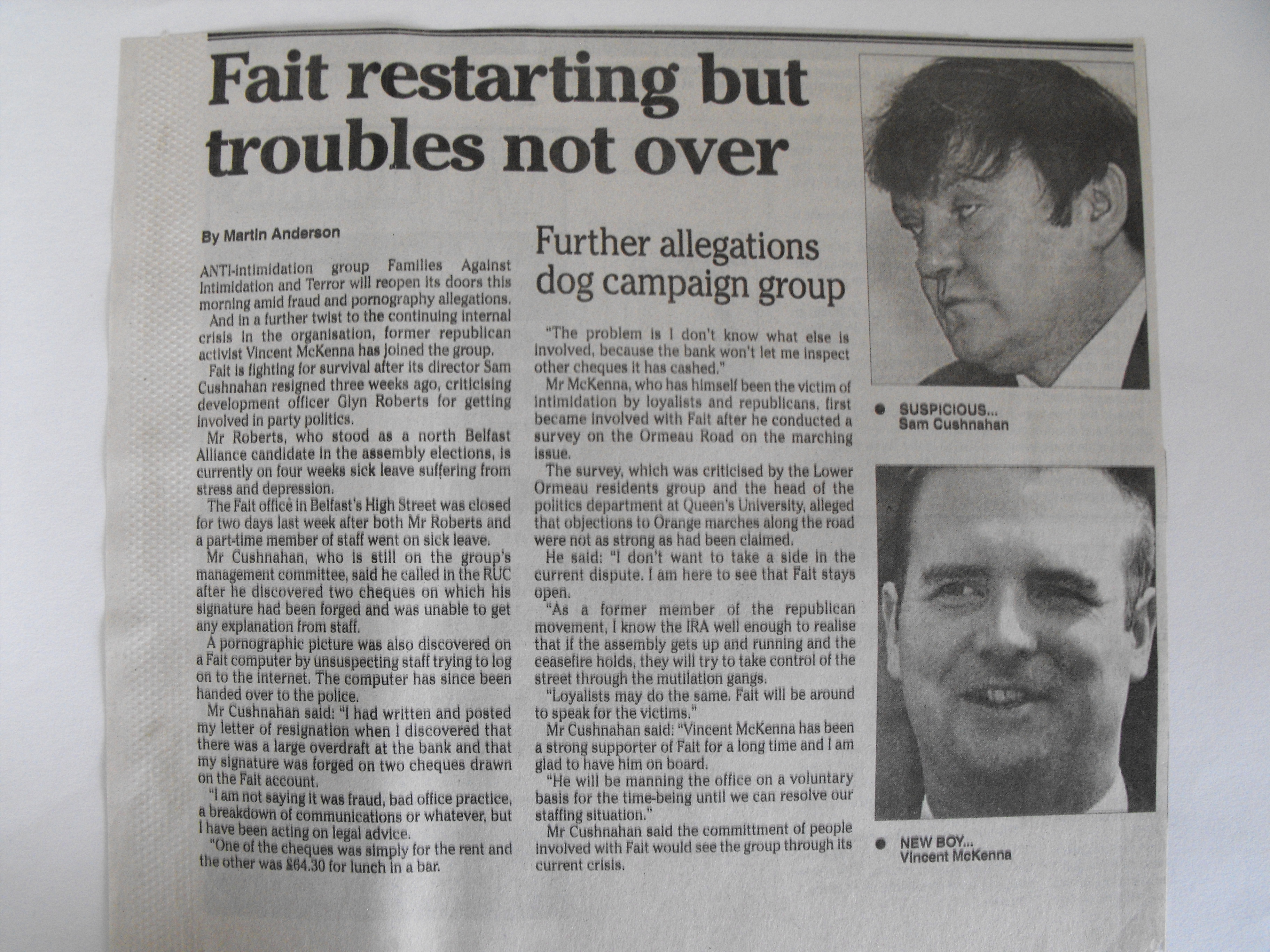


.JPG)


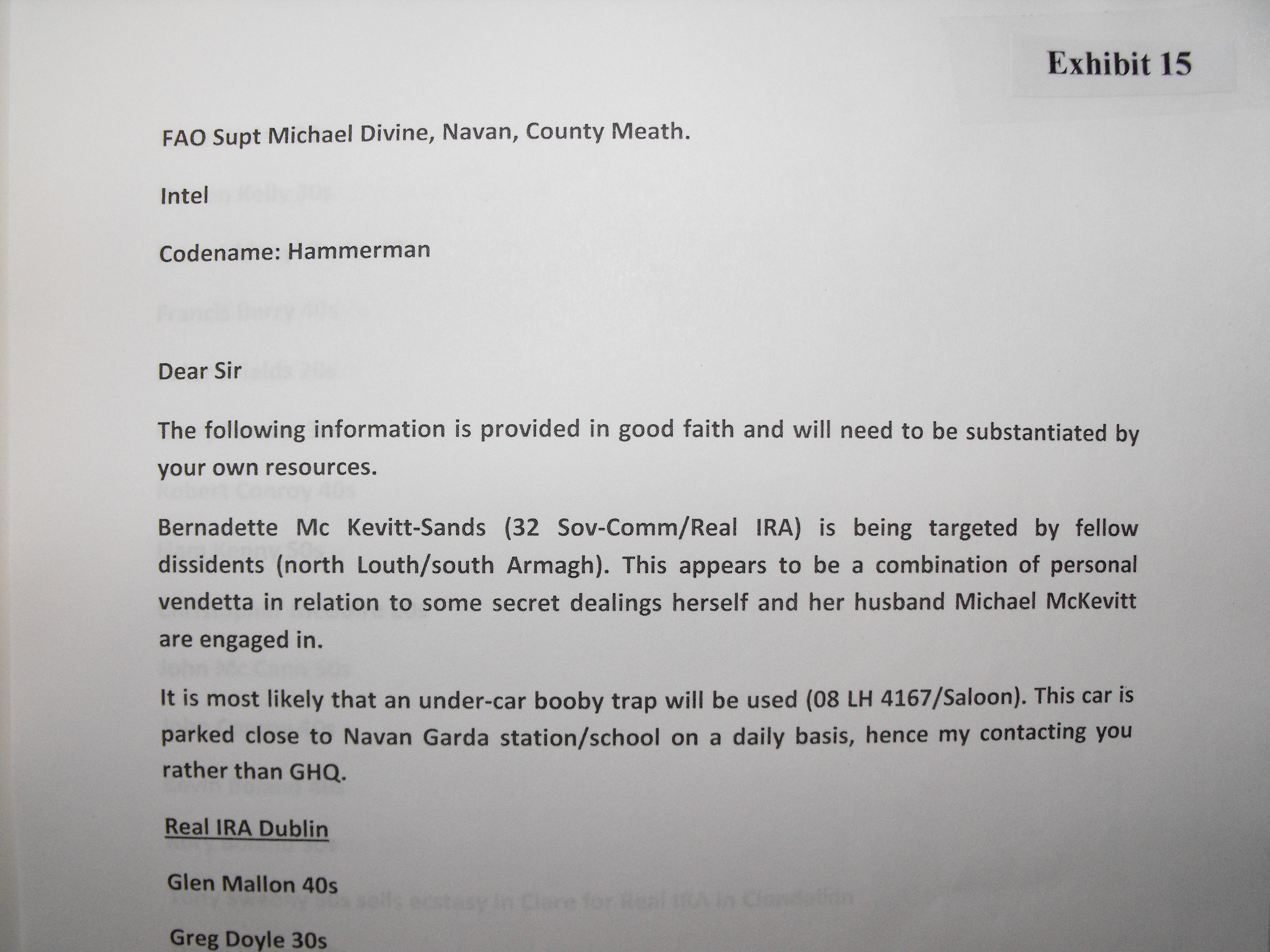


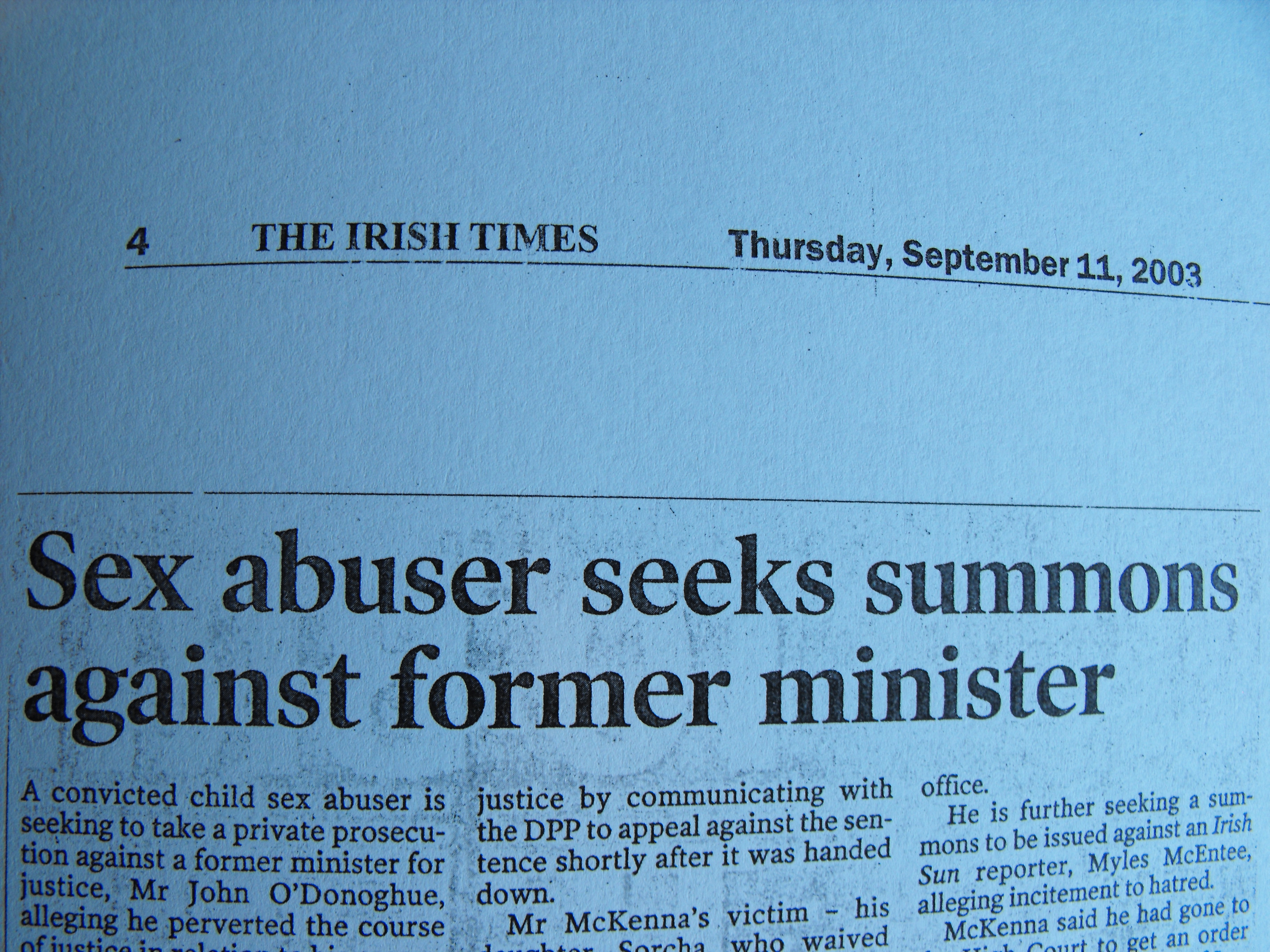


.JPG)



.JPG)